

A sponsored slot in a newsletter is almost always sold at a flat rate, per issue, and that flat rate is calculated from a CPM, the price per 1,000 opens (or per 1,000 subscribers, depending on the seller). The formula fits on one line: active subscribers, multiplied by your open rate, divided by 1,000, multiplied by your audience’s CPM. The calculator below does that math in euros, compares it with the prices listed by 321 newsletters on September 29, 2026, and produces a rate card you can copy.
All prices published in dollars are converted at the European Central Bank reference rate of October 9, 2026 (€1 = $1.1206). Amounts exclude VAT.
Sponsorship among a newsletter’s revenue streams
A newsletter makes money in four main ways: paid subscriptions, affiliate marketing (a commission on the sales you bring in), ad networks that insert ads and pay you per click or per open, and direct sponsorship, where a brand pays you for a slot in an issue. All four can be combined. Inbox Collective, a consulting firm that specializes in newsletters, recommends the flat rate per slot over the other ad pricing models, because it’s the least risky model for you: the price is known in advance and you can invoice before the send. Affiliate marketing is described there as good supplementary income and a poor main model.
Direct sponsorship starts to make sense when you can describe your readers in one sentence an advertiser understands: “3,000 building tradespeople in Wallonia,” “8,000 HR managers at small and midsize French companies.” Size matters less than precision. To find out why your readers subscribe, apply the Jobs To Be Done interview method to your newsletter.
The price survey by Book a Sponsor, a sponsor prospecting service for newsletters, includes lists of at least 500 subscribers; in its “under 5,000 subscribers” bracket, the newsletters surveyed have 2,150 subscribers at the median, and their main slot is listed at €134 at the median. If your audience is still vague, the first job is mapping your audience, before any rate card.
How a slot is priced: CPM, flat rate or click
The flat rate per slot is the most common in direct sales. CPM is mainly used to calculate that flat rate, and more rarely to bill after the fact. Pay per click (CPC) dominates in ad networks: beehiiv pays its publishers either a CPM on unique opens or per click, depending on what the advertiser chooses, and Kit, the American email platform, pays publishers per click or through programmatic ads.
The starting formula
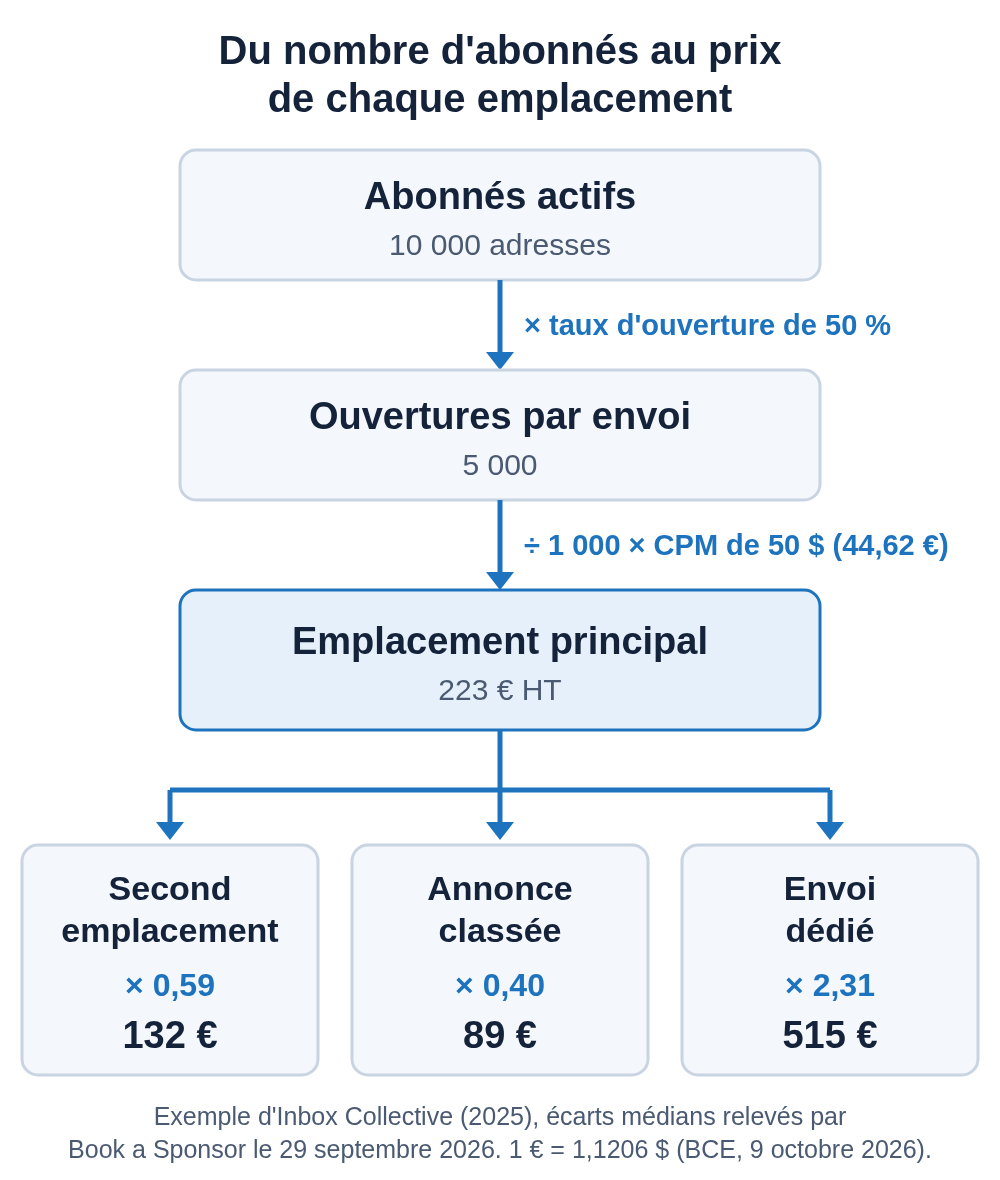
The basic calculation starts from your average opens. Take a newsletter with 10,000 subscribers and a 50% open rate: 5,000 opens per send. At a $50 CPM, the slot is worth 5 × 50 = $250, or €223.
That’s the example Inbox Collective uses, adding that the same slot is only worth $200 (€178) if the open rate drops to 40%. So the price follows your open rate, and that rate should be measured as an average of recent sends, never on your best issue.
Some marketplaces calculate CPM on sends rather than opens. Spencer, a French marketplace for B2B newsletter sponsorship, defines CPM on its blog as a “cost per thousand sends.” Before comparing two CPMs, always check what they’re based on: a CPM on sends is mechanically lower than a CPM on opens for the same ad.
Published CPMs by audience
In its guide to pricing models published on February 5, 2025, Inbox Collective gives the CPM ranges newsletters use most, which the author recommends applying to opens. Most fall between $20 and $40, or €18 to €36.
Local newsletters often get $50 to $100 (€45 to €89). Professional newsletters charge $75 to $150 (€67 to €134), and hard-to-reach audiences, such as the public sector or sales professions, sometimes go up to $200 (€178). The same guide puts ad networks’ per-click payouts between $1 and $2 in most cases, or €0.89 to €1.78.
Spencer publishes higher figures in euros for 2026, from €50 to €250 per 1,000 sends in B2B, with €100 to €200 for SaaS and tech newsletters. These ranges cite no source data: treat them as a seller’s sales pitch. They show what a B2B advertiser is being told, with no published survey to back them up.
Listed prices by list size
Book a Sponsor publishes a price survey, posted on June 11, 2026 and updated on October 2, 2026. On September 29, 2026, the company recorded the main slot price of 321 newsletters that list a rate and at least 500 subscribers on their “Advertise” page. Of those prices, 259 come from Passionfroot storefronts.
Newsletters that only give prices on request aren’t included, and the study doesn’t break prices down by topic, for lack of a large enough sample. These are prices listed on a given day: actual deals can close above or below them.
| List size | Newsletters surveyed | Subscribers (median) | Main slot (median) | 25th to 75th percentile | Price per 1,000 subscribers (median) |
|---|---|---|---|---|---|
| Under 5,000 | 68 | 2,150 | €134 | €85 to €235 | €62.32 |
| 5,000 to 19,999 | 96 | 10,000 | €277 | €213 to €458 | €32.39 |
| 20,000 to 49,999 | 76 | 31,650 | €464 | €268 to €915 | €17.16 |
| 50,000 to 99,999 | 41 | 70,261 | €625 | €402 to €1,249 | €9.40 |
| 100,000 and up | 40 | 172,000 | €1,160 | €419 to €2,733 | €5.94 |
Checked on October 10, 2026 on the study’s page (update of October 2, 2026). Method: the study’s dollar amounts divided by the ECB reference rate of October 9, 2026 and rounded to the nearest euro. This table is reviewed with each new edition of the survey and at least once a year, using the ECB rate on the day of the update. The two top brackets have about forty newsletters each: their medians are only a rough guide.
The total price rises with list size, but more slowly: according to Book a Sponsor’s fitted curve, doubling the number of subscribers raises the slot price by about 39%. So the price per 1,000 subscribers drops sharply as the list grows, from €62 under 5,000 subscribers to less than €6 above 100,000. A small, targeted list sells at a high price per contact; a large list sells on its reach.
Price gaps between slots
The same survey measures the price of other formats relative to the main slot. The second slot in the same issue sells at 59% of the main price at the median, the classified ad (a short text, often at the bottom of the issue) at 40%, and the dedicated send, a whole issue devoted to a single advertiser, at 2.31 times the main price. Spencer gives similar orders of magnitude: 0.6 to 0.8 times for a slot in the middle or at the bottom of the issue, 2 to 3 times for a dedicated send.
Handle the open rate with care
The open rate, the basis for the whole calculation, has become a fragile number. On iPhone, the “Mail Privacy Protection” feature hides the reader’s IP address and, according to Apple’s support page, also prevents senders from seeing whether you opened the message. Apple says, on its page about the feature, that it downloads remote content in the background by default, whether or not you engage with the email: tracking pixels load with no actual reading, which inflates opens on lists where readers use Apple Mail heavily. A rate above 70% should be a red flag before you show it to an advertiser.
In France, the measurement itself is regulated. On April 14, 2026, the CNIL, France’s data protection authority, published a recommendation on tracking pixels in emails (deliberation no. 2026-042 of March 12, 2026, in French). It considers that analyzing the open rate to measure and optimize campaign performance requires the recipient’s consent. For a newsletter, the exemption is limited to measuring individual opens for deliverability purposes, reduced to what is strictly necessary to space out or stop sends to inactive contacts.
For addresses collected before publication, the CNIL only asks that recipients be informed within three months and be able to object to tracking. If you write to French readers, the opens you present to an advertiser should therefore come from subscribers who accepted that tracking or, for a list that predates April 14, 2026, from those who were informed and didn’t object. Be ready to explain how your email platform collects that consent. Belgium has transposed the same EU “ePrivacy” directive; check the position of its Data Protection Authority before selling open figures.
Clicks aren’t a perfect safe haven either. Inbox Collective cites a study by the email platform Omeda finding that 63% of clicks in emails came from bots, and beehiiv calculates its per-click payout on “payable” clicks, which differ from the raw number shown in the stats.
The most robust measurement happens on the advertiser’s side: a promo code specific to your newsletter, or a landing page reserved for your readers. Bring it up in the very first conversation. It protects your price better than a disputed open rate.
The rate calculator
The calculator below applies two methods to your figures. The first multiplies your opens by Inbox Collective’s CPMs for your type of audience. The second places your list among the listed prices recorded by Book a Sponsor, using the study’s fitted curve and the gap between the 25th and 75th percentiles of the matching bracket. For a hard-to-reach professional audience, the calculator uses $150 to $200 (€134 to €178), our reading of the $200 ceiling cited by the guide.
The other slots are derived from the main slot using the median gaps from the same survey.
Sponsorship rate calculator
Enter your newsletter’s figures. The calculation runs in your browser: nothing is sent, nothing is stored. Prices in euros excluding VAT, benchmarks converted at the ECB rate of October 9, 2026 (€1 = $1.1206).
Your rate card, ready to copy
Benchmark sources: prices listed by 321 newsletters, recorded on September 29, 2026 by Book a Sponsor (main slot, gaps between slots); CPM ranges published by Inbox Collective (February 2025). Dollar to euro conversion at the ECB reference rate of October 9, 2026. These benchmarks don’t replace the prices your advertisers actually accept.
Reading the result
The suggested starting point follows a simple rule. If your CPM price falls within the range of listed prices for your list size, the calculator uses the middle of your range. If it's below, it uses the top of your range, since comparable newsletters list higher prices. If it's above, it uses the bottom, and reminds you that the gap is only defensible if you can prove how precise your audience is.
Book a Sponsor's listed prices don't separate topics, which may explain why a well-targeted professional audience lands above the range.
The cost per click, if you enter a click rate, is a reality check. An advertiser buying on performance compares your flat rate divided by your clicks with the €0.89 to €1.78 that ad networks pay per click. A €3 cost per click is still sellable for a hard-to-reach audience, provided you also sell the brand awareness and context your newsletter offers.
Leave room to negotiate, too. Book a Sponsor's survey covers listed prices, and a first advertiser may ask for a launch discount or a bundle of several issues.
Sample rate cards to copy
The calculator generates a rate card with your figures. The three templates below are for when you'd rather start from fixed text: replace the brackets with your values, remove the formats you don't sell, and keep the terms, which settle deadlines, the ad label, cancellation and payment in advance. Each version covers a different situation.
Version 1, a newsletter under 5,000 subscribers
This version suits a young or niche newsletter selling its first slots. It limits the offer to two formats and includes a trial offer, because advertisers are more hesitant to test a small list.
RATE CARD [Newsletter name], valid until [date]
Audience: [number] active subscribers as of [date], [number] average opens over the last 10 sends (measured with [tool], counting only subscribers who accepted tracking).
Readers: [profession or interest], [country], [what they buy].
Schedule: [day], [frequency].

Main slot (top of the issue, logo + 60 words + 1 link): € [main price] excl. VAT
Classified ad (bottom of the issue, 25 words + 1 link): € [main price x 0.40] excl. VAT
Trial offer: first main slot at € [main price x 0.80] excl. VAT, once per advertiser.

Terms
One advertiser per issue.
Copy and image provided 5 business days before the send; we can write the ad from your page.
"Advertisement" label and advertiser name above each ad.
Report 7 days after the send: number of sends, clicks on the link.
Payment at booking. Free cancellation up to 7 days before the send.
Contact: [email address]
Version 2, a professional newsletter
This version is for a B2B newsletter with 5,000 to 50,000 subscribers, read by identifiable professions. It breaks the audience down by job function and industry, because that's what a business advertiser is buying, and adds the dedicated send.
RATE CARD [Newsletter name], valid until [date]
Audience: [number] active subscribers as of [date].
Job functions: [x]% executives, [y]% [function], [z]% [function]. Industries: [industries]. Countries: France [x]%, Belgium [y]%.
Average opens: [number] per send (measured with [tool], counting only subscribers who accepted tracking). Average ad click rate over 3 months: [x]% of sends.
Schedule: [day], [frequency].

Main slot (top of the issue, logo + 80 words + 1 link): € [main price] excl. VAT
Second slot (middle of the issue, 50 words + 1 link): € [main price x 0.59] excl. VAT
Classified ad (bottom of the issue, 25 words + 1 link): € [main price x 0.40] excl. VAT
Dedicated send (full issue for a single advertiser, copy approved together): € [main price x 2.31] excl. VAT
Quarterly bundle (6 main slots): € [main price x 6 x 0.85] excl. VAT

Terms
Category exclusivity in the issue (one advertiser per industry).
Copy and image provided 5 business days before the send; proof sent 2 days before for approval.
"Advertisement" label and advertiser name above each ad.
Promo code or dedicated landing page recommended to measure results on your side.
Report 7 days after the send: sends, clicks on the link, opens measured with consent.
Invoice at booking, payment within 30 days. Free cancellation up to 10 business days before the send, 50% after that.
Contact: [email address]
Version 3, a local newsletter
This version is for a city or regional newsletter whose advertisers are shops, venues, real estate agencies or local governments. It replaces the dedicated send with a monthly partnership, which is easier to sell to a shop owner.
RATE CARD [Newsletter name], valid until [date]
Audience: [number] active subscribers as of [date], [x]% of them in [city] and neighboring towns.
Schedule: [day], [frequency].

Main slot (top of the issue, photo + 60 words + 1 link): € [main price] excl. VAT
Events calendar listing (20 words + 1 link): € [main price x 0.40] excl. VAT
Monthly partnership (4 main slots + a listing in the month's events calendar): € [main price x 4 x 0.80] excl. VAT

Terms
Booking no later than [day] of the week before the send.
Photo in [format] and copy provided with the booking.
"Advertisement" label and business name above each ad.
End-of-month report: sends and clicks on your links.
Payment at booking.
Contact: [email address]
Where to find advertisers
Direct outreach
The best prospects are brands that already pay newsletters similar to yours. Subscribe to a dozen newsletters in your topic, note the advertisers that keep coming back, and read their "Advertise" pages to learn their formats and, often, their prices. Add the tools and services your readers already buy, the ones they mention when they reply to you. For a local newsletter, you build the list by walking around town: new shops, performance venues, real estate agencies, events. To build that list from public sources and keep it in a spreadsheet or a CRM, see our guide to GTM engineering.
The first message should fit on one screen: who reads your newsletter, with dated figures, a specific ad idea for that brand, the price and two possible dates. The rules for email and LinkedIn outreach, and how to prepare follow-ups, are detailed in our guide to B2B prospecting with Claude.
Marketplaces and ad networks
The platforms fall into two families: marketplaces, where you set your price and the advertiser books, and ad networks, which offer you per-click or CPM campaigns at prices they set. The table below sums up their published terms.
| Platform | Type | Origin and market | Published terms |
|---|---|---|---|
| Spencer | Marketplace and per-click campaigns, B2B | France, French-language newsletters | Claims 270 B2B newsletters and more than 10 million subscribers; advertiser rates on quote; publisher terms not published on the home page. |
| AdBooker | Marketplace with online booking | France | The advertiser picks a date, adds its creative and pays; payment through Stripe; commission of 7 to 15% per booking depending on the sponsor's and the creator's plans, with the higher of the two rates applying; creator plans from €0 to €49 a month (Pricing page). |
| Media Finder | Directory of newsletters and podcasts | France, French-language media | Advertisers subscribe monthly or yearly; free sign-up for creators, with no commission on deals. |
| Passionfroot | Booking storefront and matchmaking | Germany, international | Free for creators; 2% paid by the brand on deals you bring in; 15% when Passionfroot introduces the advertiser to you. |
| beehiiv Ad Network | Network paying per CPM (unique opens) or per click | United States, international | Limited to newsletters sent with a paid beehiiv plan; 3 ads at most per issue; payout on the 20th of each month for the previous month. |
| Kit Newsletter Sponsorships | Per-click or programmatic network | United States, international | Fee of 23.5% of ad revenue; paid Kit plan required to browse per-click campaigns; payout 45 days after the end of the month. |
| Paved | Marketplace and ad network | United States, international | Claims more than 3,000 newsletters; publisher terms not published on the home page. |
Checked on October 10, 2026 on each platform's home page, pricing page or official help. Method: only terms written on those pages are included here. "Not published" refers to the page consulted; the platform may give the information on request. The table is reviewed every quarter, because these terms change often.
At Kit, the help page lists the number of US-based subscribers among the factors that determine your ad revenue. For a French-language newsletter, direct sales and French-language platforms remain the main route, with ad networks as a supplement for unsold slots.
The "Advertise" page and the media kit
The "Advertise" page on your site answers an advertiser's first questions before they write to you. It starts with a sentence about your readers, followed by the number of active subscribers with its date, the average opens with how they're measured, and the average click rate of past ads. Then come the sending schedule, the formats with an example of each, prices excluding VAT, the next open dates and the terms. End with a form or a contact address, and reply to inquiries within one business day.
The media kit repeats these elements in a two-page PDF, for advertisers who need to get the purchase approved internally. Add two or three ads you've already run, with the brands' consent, and their results if the advertiser agrees to share them. Update the figures every three months and date each page: last year's kit casts doubt on everything else.
If your newsletter also feeds your SEO or your social media, the guide to organic marketing helps you present your whole audience, beyond the email list alone.
Required disclosures in France and Belgium
In France, Article 20 of the law of June 21, 2004 on confidence in the digital economy (in French) requires any advertising accessible online to be clearly identifiable as such, and to identify the person on whose behalf it's made. So an ad in your newsletter carries a visible label and the advertiser's name. If you sign the newsletter with your own name and advertisers pay for your audience, the law of June 9, 2023 on commercial influence (in French) may also apply: its Article 5-2 requires a clear, legible and understandable disclosure of the commercial intent, such as "Publicité" (advertisement) or "Collaboration commerciale" (paid partnership).
In Belgium, Article XII.12 of the Code of Economic Law sets the same rule for online advertising: it must be identifiable as such, with the word "advertisement" shown legibly, visibly and unambiguously when it isn't obvious, and the advertiser must be identifiable, according to the Digital Wallonia fact sheet on online advertising rules (in French). In both countries, the simplest approach is to write "Advertisement" (in the language of your readers) above each ad, with the brand's name.
These rules come on top of your subscribers' consent to receive the newsletter and the CNIL's recommendation on pixels. If your model relies on measuring individual readers, have your setup reviewed by your legal adviser.
Reporting and renewal after the send
The report is what brings an advertiser back. Send it seven days after the issue, with the number of sends, the clicks on their link, the opens if you measure them with consent, and a screenshot of the ad as it ran. beehiiv, for example, counts clicks on an ad for the 72 hours following the send and delivers its report, with clicks or verified opens, after 96 hours: waiting a week gives late readers time to catch up.
Ask the advertiser what they measured on their side, with the promo code or the dedicated page. That's the information that lets you adjust your price for the next issue.
Offer the renewal in the same message, while the results are fresh, with a date and a bundle of several issues. Keep a table of each advertiser, their price, their results and the follow-up date: after six months, that table will tell you better than any survey what your audience is worth.
This follow-up work is repetitive: reminders, reports, the slot calendar. The MACCUS AI assistant helps you on Telegram, in French, English or Dutch: you send it your figures or a voice message, it prepares the draft of the report or the reminder, and you review it before it goes out.