

A client who has just chosen you knows why they did it, even if they’ve never put it into words. The Jobs To Be Done method (often shortened to JTBD) is a way to recover that why: in an interview of about 45 minutes, you reconstruct the story of their decision, from the day they started thinking about it to the moment they said yes.
Here you’ll find the complete script (adapted for service businesses), four variants, an analysis canvas, three small business examples and the method for turning it all into the copy on your website and in your ads. The script and the canvas are also available as a Word file (in French).
The Jobs To Be Done method in plain terms
The method is associated with Clayton Christensen, who was a professor at Harvard Business School. The guide from The Re-Wired Group, Bob Moesta’s consulting firm, says that Moesta developed it with him starting in the mid-1990s. The Christensen Institute sums it up this way: a customer “hires” a product or service to make progress toward a goal, in a specific situation.
For The Re-Wired Group, a person’s situation explains a purchase better than their age or income. The same person can buy a less sugary milkshake at 8 a.m. to last until lunch, and a sweeter milkshake in the afternoon as a treat.
The classic example is the milkshake, told by HBS Working Knowledge in February 2011. A fast food chain wanted to sell more milkshakes. It first asked customers who matched its typical profile to describe the ideal milkshake, followed their answers, and sales didn’t move.
A researcher close to Christensen then spent a day in one of the chain’s restaurants: 40% of milkshakes were sold early in the morning, to go, bought by people on their way to work. Asked on their way out, most described a similar need: a long, boring commute, only one free hand, work clothes on, and the need to last until noon. The milkshake was chosen instead of a bagel or a donut.
For a small business, your competitors are therefore all the solutions a client considers in their situation, including doing it themselves, asking someone they know or waiting.
Three schools and the one that suits a small business
Three approaches go by the name Jobs To Be Done. Christensen made it a theory of innovation, set out in the article “Know Your Customers’ Jobs to Be Done” (Harvard Business Review, September 2016) and in the book Competing Against Luck, published in October 2016.
Tony Ulwick, founder of the firm Strategyn, built a quantitative method, Outcome-Driven Innovation. Strategyn claims authorship of the concept: Ulwick is said to have formulated it as early as 1990, before naming his method in 1999. Each job is broken down into eight steps (define, locate, prepare, confirm, execute, monitor, modify, conclude), a market usually has 50 to 150 desired outcomes, and a sample of customers then rates their importance and their satisfaction. The method suits a manufacturer designing a product; it’s heavy for a ten-person company.
Bob Moesta and Chris Spiek developed the “switch” interview, named after the moment a customer switches from one solution to another. Their best-known demonstration is the mattress interview, conducted in public for about 45 minutes during a workshop at the software company 37signals, and included in Competing Against Luck.
This guide follows Moesta’s approach: ten to twenty interviews are enough, with no statistical survey. Ulwick’s way of writing desired outcomes is used further down for the analysis.
The switch interview, built on a timeline and four forces
The switch interview is for people who have already made their decision, preferably recently. It reconstructs what actually happened, scene by scene, as if for a documentary. Intentions and hypotheticals (“I could have,” “I think I’d buy”) are set aside: in the mattress interview, Chris Spiek asks for that kind of answer to be struck from the notes. Two frameworks guide your listening.
The timeline of a decision
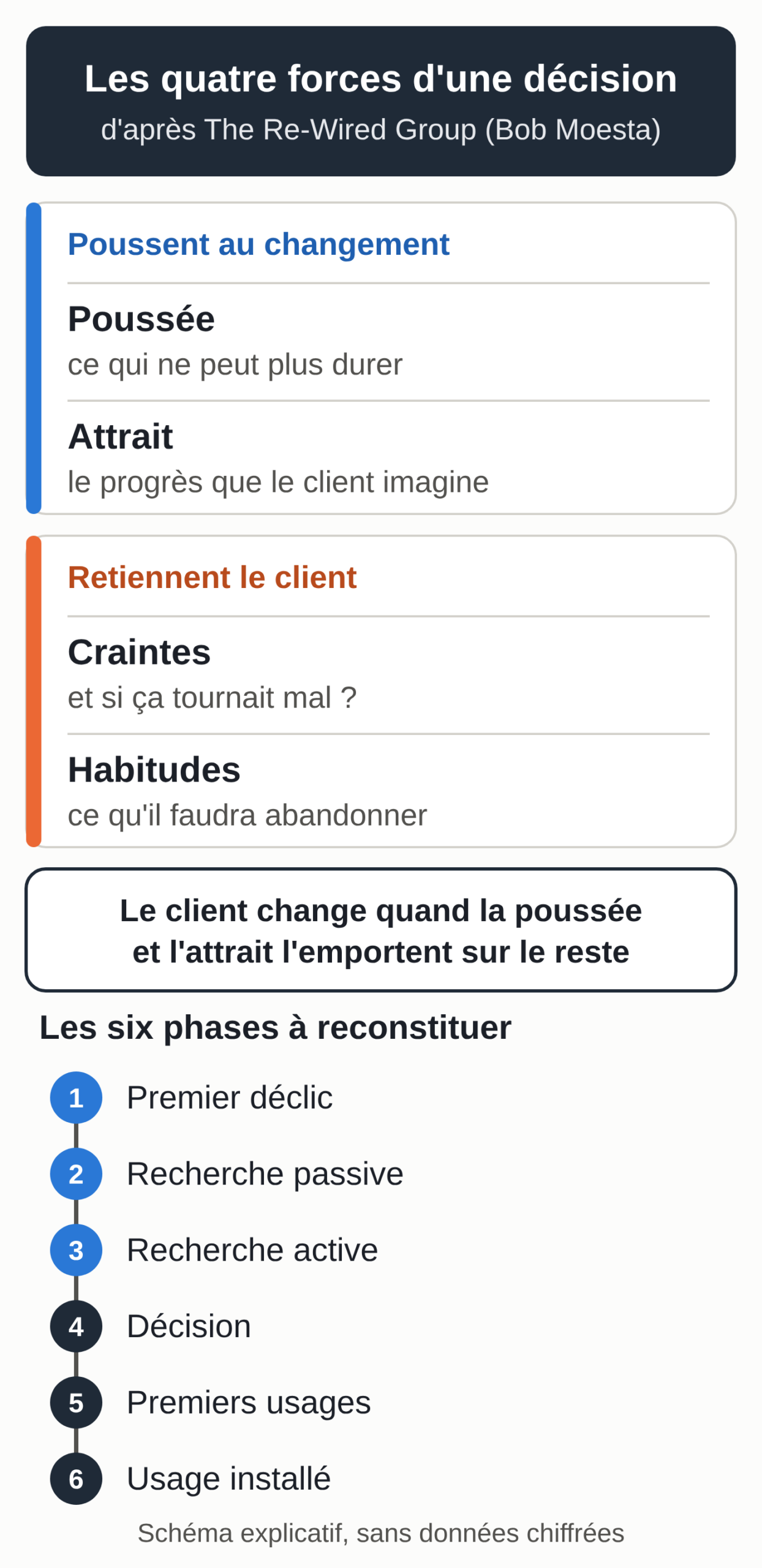
The Re-Wired Group breaks a purchase into six phases. The first thought is the moment the idea of changing appears. Passive looking comes next: the person learns, frames the problem and ranks it among their priorities to decide what to do. During active looking, they compare the options, weigh the tradeoffs, keep some options and drop others.
The decision ties these elements together: getting the agreement of the other people involved, making the final tradeoffs and settling how the result will be judged. First use then tests the choice against those expectations. Ongoing use, finally, creates new habits and sometimes new difficulties.
In the mattress interview, the person interviewed had slept badly for about a year on a sagging mattress. He flipped it, slept without a pillow, removed the box spring. After a move, he searched online for three months, sometimes in the middle of the night, and nearly bought a foam mattress on a deals site. The decision was made in a Costco aisle, at the end of a family shopping trip, when his wife touched a foam sample and gave her approval.
For the interview, focus above all on the events that move someone from one phase to the next. The jobstobedone.org site describes them this way: an event tips the customer into active looking, then a trigger forces them to decide.
The four forces of change
The Re-Wired Group names four forces: the push, the pull, anxieties and habits. The push comes from the current situation, what can’t go on. The pull comes from the new solution, the progress the customer imagines. These two forces drive change.
Anxieties are about the new thing (what if it doesn’t work, what if it costs more than expected), and habits about what the customer will have to give up. These two forces hold people back. In this model, the customer switches when the push and the pull outweigh them.
In the mattress interview, the customer had wanted a different mattress for a long time. Anxieties held him back: buying blind online, the atmosphere of mattress stores, the risk of his wife blaming him if he chose badly. Habit did too: he still hadn’t thrown out the old mattress and was still sleeping on it the night before the interview. Costco’s return policy, how close the store was and his wife’s approval made the anxieties fall away. When you prepare a sales pitch, then, work on the anxieties as much as on the benefits.
Who to interview, and how many people?
The Re-Wired Group advises talking to people who have already chosen and use your product or service, whether their experience was good or bad. Its guide says that about ten interviews can be enough if the profiles vary, and recommends fifteen to twenty when you’re starting out. It states that the approach doesn’t aim for a statistically significant result.
For a first round, pick a single offer and mostly recent clients: the memory has to be fresh. The mattress interview took place about 45 days after the purchase. Add two or three people who left or who didn’t sign your quote: they show the forces that worked against you.
In B2B, The Re-Wired Group looks for one person’s job: the person who championed the purchase internally and put their credibility on the line. Interview them first, then a second person from the group if you can.
The same guide recommends not interviewing alone and comparing your interpretations afterward. In practice, with two people, one asks the questions and the other takes notes and spots what was glossed over. If you work alone, record with the person’s consent and listen again before you fill in the canvas.
The message asking for an interview
Send it by email or text message, signed by a named person and with no sales pitch.
Subject: 30 to 45 minutes to understand your choice

Hi [first name],

You hired us in [month] for [service]. I'm trying to understand how our clients make this kind of decision, in their own words, so we can better explain what we do.

Would you be open to a 30 to 45 minute conversation, by phone or video call? There's nothing to prepare; I'll simply ask you to tell me how things went. This isn't a sales call.

Here are three time slots: [slot 1], [slot 2], [slot 3]. If none of them works, suggest another.

Thanks in advance,
[first and last name], [company], [phone]
Recording with the person’s consent
The CNIL, France’s data protection authority, counts a person’s voice as personal data. An interview recording therefore falls under the GDPR, which applies in both France and Belgium. In practice, ask for consent at the start of the recording, say what it’s for and how long you’ll keep it, store it somewhere secure and delete it once your notes are done. If you have the recording transcribed by an online tool, say so when you ask for consent. Remove names and identifying details before sharing a transcript, internally or with a tool.
The 45-minute interview script
Moesta’s team writes that it doesn’t come with a list of questions: it follows the story and fills in the timeline as the conversation goes. The script below is a safety net for your first interviews. Read the opening as written, then use the questions as prompts, in whatever order the story takes. The timings are a guide.
JOBS TO BE DONE INTERVIEW SCRIPT
Situation: recent client of a service business (purchase or signature in the last three months)
Target length: 45 minutes. Two interviewers if possible: one asks the questions, the other takes notes.

1. OPENING (3 min)
"Thank you for taking the time. I'm doing a small research project to understand how our clients make their decision, in their own words. There are no right or wrong answers, and I have nothing to sell you today. Mostly, I'll ask you to tell me a story, with details that may seem unimportant."
"Is it OK if I record, so I don't have to write everything down? The recording is only for this analysis, I won't share it and I'll delete it once my notes are done."
[Note the first names of the people mentioned (partner, spouse, accountant) and use them in your questions.]

2. THE MOMENT OF DECISION (8 min)
"Let's go back to the day you said yes. When was that, roughly? A weekday? Where were you?"
"What actually happened: did you sign the quote, call, pay online?"
"Was someone with you, or aware of it? Who had the final say?"
"Why was it that day, and not a month earlier?"

3. THE FIRST THOUGHT (8 min)
"Let's go further back. When did you first think something had to be done?"
"What happened at that moment? Where were you?"
"How did you manage before? What did you try in the meantime?"
"What made you wait before acting?"

4. THE SEARCH (10 min)
"When did you start looking for real? What triggered that?"
"Where did you look? Who did you talk to about it?"
"What other solutions did you consider, including doing it yourself or doing nothing?"
"What took each one off the list?"
"Was there a deadline, a date to meet?"

5. HESITATIONS AND THE CHOICE (8 min)
"What worried you when it came time to choose?"
"What almost stopped the whole thing?"
"What reassured you?"
"What did you have to give up to choose this solution?"
"How did you feel about the price? What did you compare it with?"

6. THE FIRST WEEKS (5 min)
"How did the first days go? Was it what you imagined?"
"How can you tell it's working, or not working?"
"Since then, has there been a moment when you doubted your choice? What had happened?"

7. CLOSING (3 min)
"Is there anything I didn't ask about that mattered?"
"May I get back to you if a question comes up when I reread my notes?"
"Do you know anyone who made a similar choice recently and would be willing to talk about it?"
Prompts that bring a memory back
The Re-Wired Group’s ten interview tips rest on a simple observation: concrete details bring the memory back, and an answer that seems irrational becomes logical once you know the context. The following prompts are drawn from them and adapted.
PROMPTS, TO USE AT ANY POINT

To bring back a memory:
"What was the weather like? Were you alone? Did you call them, or did they call you?"

To pin down a vague word:
"Fast, compared with what?"
"When you say too expensive, what amount did you have in mind?"

To create a contrast:
"Why a professional rather than your brother-in-law, who knows about this stuff?"

When the story doesn't hold together:
"Hold on, I'm a little lost. Can you tell me again in what order it happened?"

When the tone changes (a sigh, a hesitation, a stressed word):
"Hold on, tell me about that. Why did it matter?"

Before a delicate question:
"I have a slightly personal question, and you don't have to answer it: […]"

When words fail:
"What would you compare that situation to?"

When the person describes what they would do:
"And that day, concretely, what did you do?"
Four variants depending on the situation
Variants 1 to 3 keep the opening, the first thought, the search and the closing from the main script, and replace or add to the other parts. Variant 4 condenses the whole interview into seven questions.
Variant 1. The lost client
For a cancellation, a contract that wasn’t renewed or a client who left for a competitor. Here you’re asking about the “firing” of your solution.
VARIANT 1: LOST CLIENT (cancellation, non-renewal, switch to a competitor)

Add to the opening:
"My goal is to understand what happened, so we can do better with our other clients. There won't be any sales follow-up after this call."

Instead of part 2:
"When did you decide to stop? Who did you tell first?"
"When did you say to yourself: this can't go on?"
"What did you put in place instead, and how did you find it?"

Instead of part 6:
"How is it going with the new solution? What do you miss, and what don't you miss at all?"
"At what point in our work together did things start to go downhill?"
Variant 2. The quote that went nowhere
For a prospect who chose a competitor, did the work themselves or postponed their project.
VARIANT 2: QUOTE WITH NO FOLLOW-THROUGH (chose a competitor, did it in-house or postponed the project)

Add to the opening:
"You didn't choose us, and that's exactly what interests me. There won't be any sales follow-up after this call."

Instead of part 2:
"Where does your project stand today?"
"If you chose another solution: when and how was that decided?"
"If the project is on hold: what put it on pause?"

Add to part 5:
"When you received our quote, what was your first thought?"
"What weighed most heavily against us?"

Part 6: go straight to the closing.
Variant 3. A decision made by several people
For a business client where management, partners or a purchasing department had a say. Start with the person who championed the project.
VARIANT 3: DECISION MADE BY SEVERAL PEOPLE (business client: management, partners, purchasing)

Add to part 2:
"Who else took part in the decision? Who could say no?"
"How did you present the project internally? With what document, what arguments?"
"What objection had to be overcome, and who was raising it?"

Add to part 5:
"What did you personally risk if the choice had turned out badly?"
"What allowed you to defend this choice in front of the others?"
Variant 4. The short 15-minute version
For a busy private client, a phone conversation or a tradesperson between two jobs. It loses detail: keep it for running more interviews once you’ve got the long version down.
VARIANT 4: SHORT VERSION (15 minutes, one question per part)

1. "Thank you, this will take fifteen minutes. I'm trying to understand how you chose us. May I take notes?"
2. "The day you said yes, what happened?"
3. "When did you first think something had to be done, and why at that moment?"
4. "What else did you consider, including doing it yourself or waiting?"
5. "What worried you, and what reassured you?"
6. "Since then, has it gone as planned?"
7. "Is there anything else that mattered?"
The mistakes that skew an interview
The first trap is the hypothetical question. “Would you buy…” produces an answer about what the person imagines. Always bring the conversation back to what happened, on a date and in a place.
Ready-made explanations come right after. “I like it” says nothing about the cause, The Re-Wired Group notes: most people say they like pizza and steak, and the question is why pizza won that night. “It was convenient” calls for the same follow-up. Ask about the context until the choice becomes obvious.
The third trap is talking about your offer. If you defend your prices or correct a criticism, the story stops and the person tells you what you want to hear. Take notes, say thank you, and prompt again.
The last mistake is analyzing alone and too late: fill in the sheet the same day and discuss the passages you disagree on with a second person.
The four forces analysis canvas
The canvas takes the eight elements of a job described by The Re-Wired Group (context, struggling moments, pushes and pulls, anxieties and habits, desired outcomes, hiring and firing criteria, tradeoffs, basic quality) and adds the timeline. Fill in one sheet per interview. The right-hand column shows a completed sheet for a heating contractor, a fictitious case discussed further down. On mobile, scroll the table to the right to see the example.
| Section | Question to ask yourself | Example (heating contractor, fictitious case) |
|---|---|---|
| Starting situation | What was going on in the client’s life or business? | House bought two years earlier, original boiler more than twenty years old. |
| First thought | What event gave rise to the idea of changing? | A breakdown on a Sunday in January, with the kids at home. |
| Workarounds | How did they get by in the meantime? | Portable electric heaters, restarting the boiler by hand. |
| Move to active looking | What event made them look for real? | A second breakdown in three weeks and a repair quote that seemed high. |
| Options considered | Which solutions, including doing it themselves or waiting? | Repair again, a heat pump, a new boiler, wait until spring. |
| Push | What couldn’t go on? | The fear of a breakdown during the in-laws’ stay in February. |
| Pull | What progress did they imagine? | Not having to think about it all winter, an energy bill that’s easier to read. |
| Anxieties | What worried them about the change? | Messy work, a final price higher than the quote, applying for subsidies alone. |
| Habits | What tied them to the current situation? | “It always starts up again,” a repairman they’d known for ten years. |
| What reassured them | What lowered the anxieties? | A quote detailed line by line and a firm date for the job. |
| Tradeoffs accepted | What did they give up? | The heat pump, which would take too long to install before the end of winter. |
| Hiring and firing criteria | What had to be there? What would make them leave? | A job done before the end of January; a delay without notice would make them switch. |
| Basic quality | What must never go wrong for this job? | A heated house the same evening as the job. |
| Phrase to keep word for word | The client’s most telling phrasing | “I wanted to stop crossing my fingers every time it got cold.” |
| Desired outcome | Direction + metric + object + context (Ulwick’s phrasing) | Reduce the risk of being left without heating during the cold months. |
Grouping your sheets into three to five jobs
Once your sheets are filled in, lay them side by side and look for situations that resemble each other: the same kind of first thought, the same push, the same anxieties. Group by situation, whatever the type of client. The Re-Wired Group insists on this point: a job describes what a person does in a specific context, which sets it apart from a demographic segment or a persona.
The same guide aims for three to five jobs per product or service. A job that is too broad concerns everyone and helps with nothing; a job that is too narrow only concerns two or three people. Give each group a name taken from the clients’ own words, for example “get the heating back before the next cold snap.”
Writing desired outcomes the Ulwick way
Strategyn imposes a strict form on desired outcomes: a direction of improvement, a metric, the object it applies to and a contextual clarifier. Its example: “minimize the time it takes to determine the right drill bit size for the material being drilled.” According to Strategyn, the statement contains no solution, can be measured and can be tested in a survey.
Write one or two outcomes of this kind per job. They become your criteria for judging a new offer, a website page or a sales argument: does it reduce the risk or the time the client described?
Examples from three small businesses: a heating contractor, an accounting firm, a web agency
The three cases below are fictitious. They show how to read a completed canvas, and what a small business can take from it for its offer and its messages.
The heating contractor and the boiler that gives out in January
The canvas above tells the story. The push is strong (two breakdowns, children, a family visit), and so is the pull. Yet the client hesitated for two weeks, held back by anxieties: the mess of the work, the final bill, the paperwork for subsidies.
If two reasons, the firm date for the job and the easy-to-read quote, come up in most of his sheets, the heating contractor knows what to highlight. He can show these two elements on his website, next to the quote request button, and offer a quick diagnostic visit for clients still attached to their old repairman. Our page on AI for construction tradespeople shows how to prepare this kind of quote faster.
The accounting firm and the freelancer who switches accountants
A freelancer who incorporated three years ago gets a reminder from the tax authority that his accountant never mentioned: that’s the first thought. For months, he keeps his own tracking spreadsheet and chases his firm by email.
Active looking starts when an urgent question goes unanswered before a deadline. He considers staying, switching to an online firm or following a friend’s recommendation. He’s anxious about switching mid-year and losing the history; habit weighs too, with ten years of working together, first as a sole trader and then as a company, and the feeling that “he knows my file.”
What reassures him: the new firm takes care of getting the file from the old one itself. The job could be written as “know where I stand with the tax authority without having to chase anyone,” with a desired outcome such as “reduce the time it takes to get an answer to an urgent tax question.” To free up time on entering invoices and chasing documents, see our guide to AI for accounting firms.
The web agency and the redesign decided after a trade show
The sales director of a small industrial company comes back from a trade show where a prospect told her they couldn’t find her products on the website. For years, her sales reps have been sending PDF product sheets for lack of product pages. Here, several people decide: variant 3 of the script is the one to use.
The interview reveals a main anxiety, shared by the CEO: a project that drags on for a year and forces the team to write all the copy. The habit has a name, the longtime web provider, someone close to the founder. The agency that was chosen reassured them with a phased schedule and copy written from interviews with the sales reps.
The job looks like “give the sales reps pages they can send to prospects,” with a desired outcome such as “reduce the time a sales rep spends preparing documentation for a prospect.” For the agency, the right message talks about the sales reps’ daily work and the time they save on it.
From interviews to website and ad copy
Interviews give you words first. Use the “phrase to keep” column for your headlines, your hooks and your ads: your clients describe their problem in those words. For the heating contractor, “Boiler broken this winter? Job date set as soon as you get the quote” speaks to the person during active looking. The Reddit threads where your clients talk about their problem give you more: see our guide to Reddit for brands.
Anxieties then give you your reassurance points. Each anxiety that shows up in several sheets deserves a visible answer where the client decides: near the contact button, in the FAQ, on the quote. Habits are handled with an easy first step, such as a diagnostic, a short call or taking over the file for the client.
The timeline, finally, tells you what to publish and where. For The Re-Wired Group, the first thought and the two looking phases belong to marketing and sales, while the decision and use belong to sales and customer service. A “how much does it cost” guide supports passive looking, a comparison page supports active looking, and concrete proof supports the decision. That’s the logic of search intent applied to your own clients, and it complements organic marketing on your other channels.
For advertising, add the first-thought keywords to the keywords of your trade, for example “boiler broken on Sunday” in addition to “heating contractor.” If you buy a slot in a newsletter in your industry, write the ad with the same words: our guide to newsletter sponsorship covers the formats and prices in detail.
Having an AI assistant sort your notes
An AI assistant can pre-fill the canvas from an anonymized transcript. The text below can be pasted as is into the assistant of your choice. Check the result with the transcript in front of you: a model can summarize wrongly or make up a sentence.
You are an analyst trained in the Jobs To Be Done method (Bob Moesta's switch interview).
Here is the anonymized transcript of a client interview. Fill in the following canvas, section by section:
starting situation, first thought, workarounds, move to active looking, options considered, push, pull, anxieties, habits, what reassured them, tradeoffs accepted, hiring and firing criteria, basic quality, phrase to keep word for word, desired outcome.

Rules:
1. Use only what the transcript says. If a section isn't covered, write "not discussed."
2. For each section, quote in quotation marks the exact passage you're relying on.
3. Write the desired outcome as a single sentence of the form "Reduce the time (or the risk) of [object] [context]," for example "Reduce the risk of being left without heating during the cold months," without proposing a solution.
4. End with three follow-up questions to ask in a future interview, on the points that remained unclear.

Transcript:
[paste the transcript here, with no name, address, number or amount that could identify the person]
The kit to download
The Word file contains the request message, the 45-minute script, the prompts, the four variants and the canvas, with a blank sheet to print for each interview: download the Jobs To Be Done interview kit (.docx, in French).
Your first round of interviews
- Choose an offer and list its clients from the last three months, plus two or three people who left or didn’t follow through after your quote.
- Send the request message to a wide list: aim for fifteen interviews in a first round, at least ten if your profiles vary a lot.
- Run the interviews with two people if possible, recorded with the person’s consent.
- Fill in a sheet the same day, then delete the recording.
- After ten to fifteen sheets, group them into three to five jobs and write one or two desired outcomes per job.
- Rewrite one page of your website and one ad with your clients’ words, then compare with the old version. The same words work in your prospecting emails: see our guide to GTM engineering.
To dictate your notes by voice right after each interview, with no names or identifying details, and get a written summary back in Telegram, in French, English or Dutch, take a look at the MACCUS AI assistant.