

On October 12, 2026, Meta released Muse Wonder and Muse Wonder Full, the most capable AI models it has built so far, designed for agents that handle personal and professional tasks. Muse Wonder is available now through Meta’s API (the Meta Model API) and in Muse Code, Meta’s coding tool. Muse Wonder Full is limited to Muse Code subscribers.
In Meta’s own results table, its two models come out on top in half of the tests, and Anthropic’s Claude Opus 5.5 leads almost all of the rest. If your business already runs on Claude or ChatGPT, there is no rush to switch: the numbers come from Meta, the model is still in preview, and the stronger version is sold only by subscription.
Two models, and only one sold by the token
Muse Wonder, which Meta presents as the next step after Muse Spark, arrives fourteen months after the company began rebuilding its AI operation. The announcement highlights two capabilities. Active Memory keeps the context that matters about you from one conversation to the next and brings it back when it’s useful. Active Focus keeps the model working when a task gets hard: it tries another approach, works around a blocker, asks for clarification, and checks in with you before any important action.
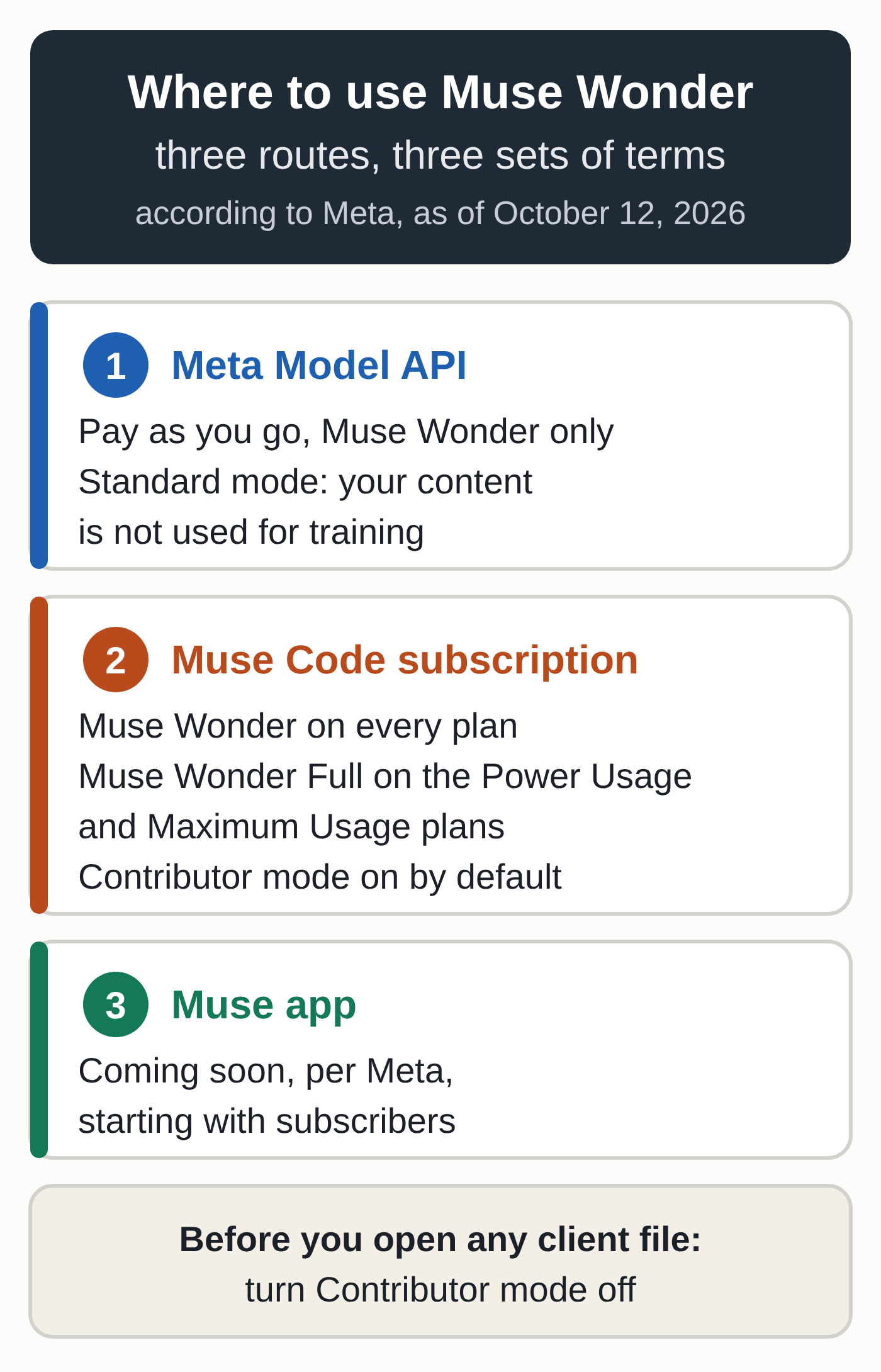
Muse Wonder (model ID muse-wonder-1.0) is available pay-as-you-go through the API and is included in every Muse Code plan. Muse Wonder Full isn’t available through the API at all; it requires a Muse Code Power Usage or Maximum Usage plan. In Muse, Meta’s consumer app, Muse Wonder is coming “soon,” starting with subscribers.
How much does Muse Wonder cost?
On the API, Muse Wonder costs $4 per million input tokens and $20 per million output tokens, or about €3.58 and €17.89 at the European Central Bank’s October 12 reference rate (€1 = $1.1181). Cached input drops to $0.20 (about €0.18). Web search adds $2.50 per 1,000 queries, and Meta charges no premium for long contexts.
Muse Spark 1.3 is billed at $1.25 for input and $4.25 for output, so Muse Wonder costs 3.2 times as much for input and nearly five times as much for output. The documentation lists a 1,048,576-token context window, input in text, image, video, audio, and PDF, and text output.
Meta’s documentation doesn’t list prices for the four Muse Code plans. According to CNBC, Muse Wonder Full is limited to plans costing $50 and $200 a month (about €45 and €179), and using Muse Wonder in the Muse app will require a $20 or $100 monthly plan (about €18 and €89). Alexandr Wang, Meta’s AI chief, told CNBC that the developer offering, while pricier than the standard subscriptions, will be priced “meaningfully below” the top models from OpenAI and Anthropic.
Meta hasn’t said whether Muse Wonder is available in France or Belgium. Its documentation says model access “can vary by country” and points to a geographic use policy whose page returned an error on the evening of October 12. The model card names the provider as “Meta Platforms, Inc. or Meta Platforms Ireland Limited,” with no list of countries. OpenRouter, which resells access to many models, already lists Muse Wonder at the same price.
Turn off Contributor mode before any client work
In “Contributor mode,” you let Meta train its future models on your prompts, code, files, the context you send, and the answers you get back, in exchange for a discounted price or more usage.
On the pay-as-you-go API, Muse Wonder runs only in Standard mode, where your content isn’t used for training. Muse Code subscriptions, on the other hand, turn Contributor mode on by default. You can switch it off at any time in settings, and anything you send afterward is no longer used for training. Do it before you open a single client file.
Meta’s benchmark results
Meta compares its two models against Anthropic’s Claude Fable 5.1 and Claude Opus 5.5 and OpenAI’s GPT-6 Astra, all run at maximum reasoning effort. Here are its numbers, shown as a success rate or a score depending on the test.
| Test (area) | Muse Wonder Full | Muse Wonder | Claude Fable 5.1 | GPT-6 Astra | Claude Opus 5.5 |
|---|---|---|---|---|---|
| Personal Superintelligence Index (Meta internal index) | 59.1 | 54.3 | 49.9 | 54.5 | 55.2 |
| Harvey LAB-AA (legal work) | 13.1 | 10.0 | 6.4 | 8.6 | 4.2 |
| Vals Finance Agent V2 (financial analysis) | 59.1 | 56.6 | 58.9 | 53.5 | 58.6 |
| HealthBench Pro (health questions) | 62.3 | 60.5 | 62.1 | 65.3 | 65.6 |
| AutomationBench-AA (business workflows) | 45.4 | 39.1 | 32.1 | 41.6 | 41.2 |
| GDP.pdf (work from PDF documents) | 33.2 | 30.8 | 27.6 | 34.2 | 30.6 |
| JobBench (office tasks) | 75.3 | 70.5 | 73.1 | 66.1 | 75.4 |
| OSWorld V2.1 (operating a computer, partial score) | 78.4 | 72.6 | 80.7 | 75.8 | 81.8 |
| MemoryBench (memory, Meta internal test) | 85.5 | 85.6 | 79.0 | 81.4 | 81.5 |
| Terminal-Bench 4.0-AA (coding in a terminal) | 57.1 | 52.0 | 52.0 | 59.1 | 59.6 |
| DeepSWE 1.1 (long-horizon coding) | 79.0 | 78.8 | 67.4 | 74.1 | 74.2 |
| SWE-Marathon (very long coding projects) | 57.5 | 53.1 | 45.6 | 42.5 | 46.3 |
| ProgramBench (writing a program from scratch) | 59.0 | 50.0 | 55.5 | 52.5 | 70.5 |
| Artificial Analysis Index (general index) | 56 | 52 | 53 | 53 | 58 |
Source: Meta, October 12, 2026. Bold marks the top result in each row. Muse Wonder Full was measured at “xhigh” effort on SWE-Marathon.
Meta’s models win seven of the 14 rows, with a clear lead in legal work and long-horizon coding. Claude Opus 5.5 wins six, including writing a program from scratch (70.5 vs. 59.0) and the Artificial Analysis Index (58 vs. 56). The remaining row, GDP.pdf, goes to GPT-6 Astra. Several of those wins come down to a few tenths of a point, including JobBench (75.4 vs. 75.3) and Vals Finance Agent V2 (59.1 vs. 58.9).
Meta’s own model card flags three caveats. Some rows come from third-party measurements (Artificial Analysis, Vals AI, Datacurve), others were measured by Meta itself, and three figures come from internal tests that no one outside Meta can rerun: the Personal Superintelligence Index, MemoryBench, and FocusBench. Where Meta ran the competitors itself, it did so on a “best-effort” basis, with settings that may not be optimal for them. And on SWE-Marathon, GPT-6 Astra and Claude Fable 5.1 were evaluated through Codex and Claude Code rather than in the same environment as Meta’s models.
If you plan to pay as you go, note that the version sold through the API isn’t the one topping the table. On the Artificial Analysis Index, Muse Wonder scores 52, below all three competitors. On FocusBench, Meta’s internal test of Active Focus, it also trails GPT-6 Astra and Claude Opus 5.5: 54.2% for Muse Wonder Full, 47.7% for GPT-6 Astra, 45.8% for Claude Opus 5.5, 44.9% for Muse Wonder, and 36.6% for Claude Fable 5.1.
Meta also published a chart on tasks the model was not specifically trained for. By our reading of the chart, at the same score on the trained tasks, Muse Wonder Full does about ten points better on the untrained ones than the Muse Spark 1.3 trend. Meta attributes the gain to a larger, stronger base model.
Safety tests and safeguards
Meta says it trained Muse Wonder not to share private information without permission and to turn down harmful requests. On the cyber misuse refusal test Meta published, which leaves out Claude Opus 5.5, the scores are 97.5% for Claude Fable 5.1, 96.9% for Muse Wonder Full, 93.7% for Muse Wonder, and 86.3% for GPT-6 Astra. On its test of how often a model mishandles personal information, where lower is better, Muse Wonder Full comes in at 2.2%.
According to CNBC, those cyber protections apply only to the paid model for now. The model card says Meta can’t rule out that the model, without safeguards, would reach its high-risk threshold in the chemical and biological domain, which is why Meta added dedicated safety training and filters around it. The card also recommends human confirmation before any irreversible action, the same precaution we cover in our article on the safeguards to put around AI agents.
Our test of the previous model
In September 2026, we ran blind comparisons of Muse Spark 1.3 against other models on translating recipe content into 23 languages. In English, Spanish, German, and Polish, its prose held its own against the best model we tested. In most other languages it fell behind, and its answers came back about six times slower than the reference model’s. On scanned invoices, it read amounts and bank account numbers correctly, but one formatting error reminded us that every extraction needs checking.
Should your business test Muse Wonder?
Yes, if you already hand long tasks or legal documents to AI, and as long as you test it on your own work. Here’s the order we would follow.
- Pick three to five real tasks (summarizing a contract, analyzing a spreadsheet, drafting a reply to a client) and run them through Muse Wonder on the API and through the model you use today, with the same instructions.
- When you open the account, check that access works from your country: Meta’s page on country restrictions wouldn’t load on the evening of October 12.
- In Muse Code, turn off Contributor mode before the first client file.
- Watch your usage during the trial. An agent that chains steps often resends its whole context on every call, so the cached-input rate ends up driving the bill.
- Require human sign-off on anything that sends, pays, or deletes.
To see where Muse Wonder fits among the models you already know, read our guide to OpenAI’s GPT models. If price is your main concern, Claude Haiku 5.5 is 40 times cheaper through the API, on both input and output, for requests of up to 100,000 tokens.
Open questions
As of the evening of October 12, no independent group had rerun the full set of tests, and the complete safety report, promised “soon,” was still unpublished. Meta gives no French-language results: its model card only says the model hasn’t been evaluated in every language and that performance may drop outside the best-supported ones.
Read next
- Google AI Mode and AI Overviews: what they do to your clicks
- The llms.txt file: who reads it, template and generator
- Agent-ready website: WebMCP and the audit checklist
- MCP servers for small businesses: the directory
- AI visibility tools compared (October 2026)
If you’d rather have an assistant set up for your business without tracking every new model yourself, take a look at our AI assistant.