

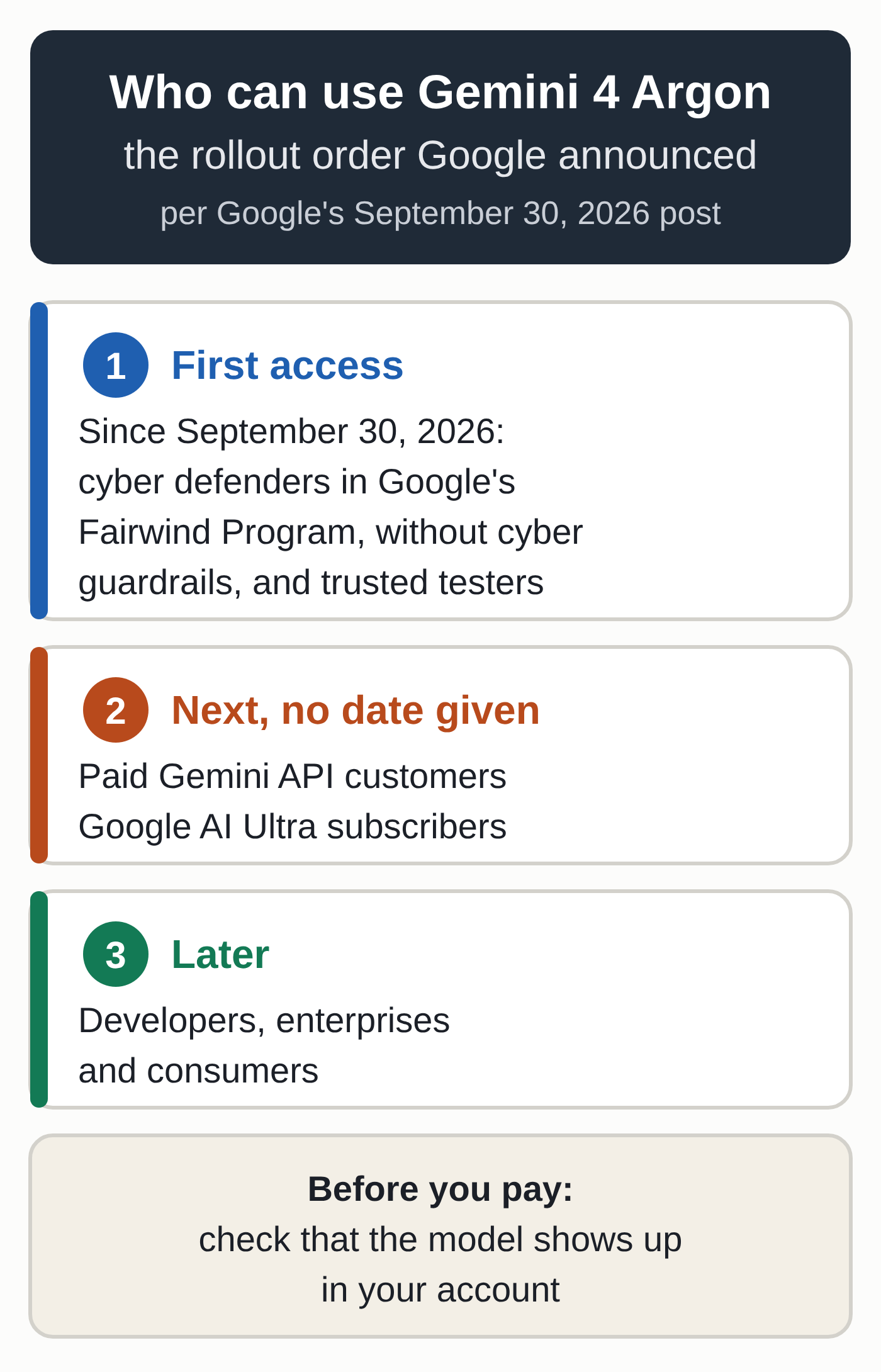
Google announced Gemini 4 Argon, its new frontier model, on September 30, 2026. It is built for long tasks: coding, legal and financial work, and cyber defense. Two weeks later, almost nobody can use it. Access is officially limited to cyber defenders in Google’s Fairwind Program, a group of trusted testers and Google’s own internal teams.
On October 13, a one-word post from a Google executive revived rumors that Google AI Ultra subscribers were getting it right away. The day before, Meta launched Muse Wonder, its new top-tier model, available through its API from day one.
Status as of October 13, 2026, 10:07 a.m. Brussels time: no official Google page says Argon is available to Ultra subscribers or API customers. The September 30 announcement hasn’t been updated, the Gemini app release notes stop on that date, and Argon is missing from the Gemini API model list, pricing page and changelog. The signs of an imminent launch remain unconfirmed.
A Gemini with no Pro or Flash in its name
Argon drops the “Pro” and “Flash” labels of earlier Gemini models, a change 9to5Google describes as a new naming scheme. The site also points out that the model arrives after Google abandoned Gemini 3.5 Pro to focus on Gemini 3.8 Flash.
The biggest technical change is output length. Argon can generate up to 1 million output tokens, compared with about 64,000 for earlier Gemini models. Google says that gives the model room to reason and write across hundreds of thousands of tokens in a single response, so it can work through a hard problem in one pass.
Who can use it, and when
The Fairwind defenders, admitted after a review by Google, get Argon without cyber guardrails so they can use its full defensive capabilities.
Everyone else will get it “as soon as possible,” the announcement says, with no date attached. Paid API customers and Google AI Ultra subscribers come first, followed by developers, enterprises and consumers.
On October 13, Logan Kilpatrick, who leads Google AI Studio and the Gemini API, posted one word on X: “Gemini.” HuggingNews, a news site that aggregates posts from X, says Google has confirmed that Ultra subscribers now have access. It doesn’t cite any Google page, though: the sources it lists are posts on X. Italian tech writer Pasquale Pillitteri checked the same day and found no official confirmation.
The kie.ai blog, updated on October 11, reported the model in Vertex AI under the ID gemini-4-argon-cyber-permissive and in the Antigravity command-line tool. Google hasn’t confirmed any of these sightings, so treat them as leaks.
How much will Argon cost?
Google has announced an introductory API price of $2 per million input tokens and $10 per million output tokens, about €1.79 and €8.94 at the European Central Bank’s October 12 reference rate (€1 = $1.1181). Cached input costs 95% less, at $0.10 per million. After the introductory period, the price rises to $4 and $20 (about €3.58 and €17.89), and Google hasn’t said how long that period will last.
| Model (price per million tokens) | Input | Cached input | Output |
|---|---|---|---|
| Gemini 4 Argon, introductory price | $2 | $0.10 | $10 |
| Gemini 4 Argon, later price | $4 | $0.20* | $20 |
| Claude Opus 5.5 (Anthropic) | $4 | $0.20 | $20 |
| Muse Wonder (Meta) | $4 | $0.20 | $20 |
| GPT-6 Astra (OpenAI) | $10 | $1 | $50 |
Source: Google’s September 30, 2026 announcement for Argon; Anthropic, Meta and OpenAI pricing pages, checked on October 12 and 13, 2026. GPT-6 Astra: standard short-context pricing. *Our calculation, assuming the 95% cached-input discount stays in place: Google has only published $4 and $20.
At full price, Argon will cost the same as Claude Opus 5.5 and Muse Wonder, the model Meta launched on October 12. GPT-6 Astra remains 2.5 times as expensive on both input and output.
In France and Belgium, Google AI Ultra costs €99.99 a month with five times the usage limits of Google AI Pro, or €219.99 a month for twenty times the limits, according to Google’s pages checked on October 13. Google AI Pro, at €21.99 a month, isn’t among the plans Google says will get Argon first.
Argon versus Claude Opus 5.5, GPT-6 Astra and Muse Wonder
Google’s own table compares Argon with GPT-6 Astra, Claude Fable 5.1 and Claude Opus 5.5 on 18 tests spread across 19 rows. Argon comes first or ties on 14 of those rows.
Three of the gaps matter for office work. On Harvey’s legal agent benchmark, Argon scores 19.6%, compared with 3.8% for Claude Opus 5.5 and 5.4% for GPT-6 Astra. It reaches 65.4% on Vals Finance Agent v2, a financial analysis test, against 58.6% for Opus 5.5. On AutomationBench, Zapier’s test of business workflows, it scores 51.3% to Opus 5.5’s 42.5%.
Claude Opus 5.5 keeps the lead on Terminal-bench 4.0, which measures coding work in a terminal (66.4% versus 57.4%), and on PostTrainBench. GPT-6 Astra leads on three rows, including computer use on OSWorld-2.0 (72.6% versus 69.2%, with no published score for the Claude models) and FrontierSWE v2 (65.5% versus 55.0%).
Every one of these numbers comes from Google. On the independent Artificial Analysis leaderboard, checked on October 13, Argon has an index score of 53, tested at its “high” reasoning setting. That ties GPT-6 Astra and Claude Fable 5.1 at their maximum settings and is one point ahead of Muse Wonder, the version sold through Meta’s API (52). It trails Claude Opus 5.5 at the same setting (54) and at maximum (58), as well as Claude Sonnet 5.5 and Muse Wonder Full (56 each).
Bloomberg reported on September 30 that some Google employees with access to the model had doubts about its performance in key areas, coding among them. Google told Bloomberg it would be “inaccurate” to say Gemini 4 is underperforming in areas such as coding.
For a small business, the difference that matters most right now is availability: you can use Claude Opus 5.5, GPT-6 Astra and Muse Wonder today. To pick among the three, start with our guide to choosing an AI model and organizing work across several agents.
Is Google AI Ultra worth it for Argon?
Not yet. Google hasn’t announced a date or usage limits for Argon on Ultra, and nothing says every country where Ultra is sold will get it at the same time. Paying €99.99 a month on a rumor means paying for access your account may not have yet.
Think about your data, too. A Google AI subscription on a personal Google account is covered by the Gemini Apps Privacy Notice, and the commitments Google makes for Google Workspace don’t apply to it. Before you upload client documents, adjust your activity settings using our guide to turning off AI training on your data, tool by tool.
If you already pay for Ultra for other reasons, such as storage or higher limits in Antigravity, just keep an eye on the model picker in the Gemini app.
Getting ready for Argon
- Wait until the official model ID shows up in the Gemini API model list, its changelog or the model picker in the app. If the model isn’t listed there, it isn’t open to your account, no matter what screenshots are going around.
- Pick three to five real tasks (summarizing a contract, analyzing an accounting export, drafting a response to an RFP) and keep the instructions identical, so you can compare Argon with your current model the day it arrives.
- Test on low-stakes data first. If you’re in the European Economic Area, Switzerland or the United Kingdom, the Gemini API terms apply the paid-service rules even to Google AI Studio and the free tier: Google says it doesn’t use your prompts or its responses to improve its products, but it keeps them for a limited time to detect abuse. Outside those regions, content sent through Google AI Studio or the free tier can be used to improve Google’s products and read by human reviewers.
- Budget for the full price of $4 and $20, since Google hasn’t set an end date for the introductory price. Set a spending cap too: a single 1-million-token response would cost $10 at the introductory price, then $20, not counting input tokens.
- Spell out the rule in your internal AI use policy: which tool, on which account, with which data.
Cybersecurity at the center of the launch
Google says Argon can find, validate and patch critical software vulnerabilities on its own. On CWE-bench v1, which measures how well a model fixes vulnerabilities, it scores 68%, tied with GPT-6 Astra. Security company Wiz used it in its Scan for Good program. According to Google, the model found a critical vulnerability exposing sensitive personal data in healthcare software used by hospitals around the world.
Google also calls Argon its most resilient model against indirect prompt injection, in which malicious instructions hidden in a web page or document hijack the AI that reads them.
For freelancers and small businesses, the effect is indirect. If models like this find vulnerabilities faster, install updates for your website, its plugins and your software as soon as they come out. If you connect an agent to your email or documents, require a human sign-off before every send, payment or deletion, as we explain in our article on the safeguards to put around AI agents.
Open questions
Google hasn’t published any results for French-language tasks, and independent measurements will stay scarce until access opens up. We’ll update the status line at the top of this article as soon as an official Google page confirms the rollout.
Read next
- With Claude, a Harvard physicist produced 36 manuscripts across 18 fields in three months
- AI that copies itself onto cheap TV boxes? Anthropic says it may be months away
- ChatGPT GPTs are ending: GPT-5.5 leaves October 14, custom GPTs December 11
- WordCraft, GridCraft, DeckCraft: a free Word, Excel and PowerPoint alternative built with Claude
- Claude Haiku 5.5: up to 90% cheaper, and what that means for your business
If you’d rather have an assistant set up for your business without tracking every new model yourself, take a look at our AI assistant.