

Since mid-September, some of the search result pages Google sends to rank-tracking tools don’t match what real searchers see. On October 10, 2026, Nozzle, which makes a rank tracker, published a study of 27.5 million result pages gathered in 49 countries. Nozzle found that 8.0% of pages collected since September 13 were “poisoned,” up from 0.17% before: complete and normal-looking, but showing different sites than usual. Belgium is among the hardest-hit countries at 13.2%, compared with 3.9% for France.
If your tool or your agency has flagged a sharp drop since September, it may exist only in the data. Barry Schwartz of Search Engine Roundtable covered the study on October 12 and called this bad data more worrying than outright blocking, because a tool may not notice it. Two other vendors, Sistrix and Morningscore, describe similar problems in their own data. Google hasn’t commented publicly.
Normal-looking pages, different sites
A poisoned page shows no error message and no CAPTCHA. According to Nozzle, it uses Google’s usual layout, and nothing in its code sets it apart from a normal page. The only giveaway is the keyword’s history: the page has fewer than half of the sites that usually rank in the top 10, and those sites return a few days later.
Nozzle points to the US search “white label local seo.” All nine sites on page one disappeared between October 4 and October 7. Their replacements included a tool for web developers, a Jackson Hole steakhouse, a directory of county health departments, and USA.gov. On the poisoned page, pagination stopped at page 3, compared with 10 pages on October 4.
Social networks and forums fill some of the vacated spots. Reddit shows up in the top 10 of 28.8% of poisoned pages, versus 20.8% of other pages for the same keywords, and Facebook rises from 28.3% to 33.8%. Ads and Shopping results, by contrast, keep most of their usual content.
A site that normally ranks in a keyword’s top 10 is missing from it on 58.6% of poisoned pages, compared with 2.7% between August 20 and September 9. Its rank tracker then records a drop that searchers never saw.
A timeline that overlaps the spam update
It started with blocking. On September 18, Search Engine Roundtable reported that Google seemed to be getting better at blocking the bots that scrape its results, starting around September 13. Nozzle said at the time that it was getting about 80% less data.
The first poisoned pages showed up in Nozzle’s data on September 20. The rate peaked between September 27 and 29, when up to 27% of pages were affected. From October 1 to October 9, it hovered between roughly 5% and 11% a day.
Morningscore saw a slightly different version of the problem. In an October 8 post, the company says it began receiving truncated result lists for some of its automated searches on the night of September 24, with a peak of about 60% on September 30 and October 1. For almost six days, its tool logged these gaps as real ranking drops. Morningscore says it has since corrected the rankings it could identify.
A Sistrix support note dated October 7 says that since September 2026, Google has been returning results that “look like genuine search results but contain different websites.” According to PPC Land, another vendor, DemandSphere, estimates that about 11% of its daily rank checks are affected.
The timing muddies the picture. Google’s September 2026 spam update, a real algorithm change, ran from September 24 to October 8, according to Google’s status dashboard. As PPC Land points out, a real drop and a fake one looked the same in a rank tracker during those two weeks. We covered the update itself in our article on the September 2026 spam update, then the Search Console delays and incomplete tool data in our October 12 article on measuring the spam update.
Belgium hit far harder than France
Nozzle publishes the poisoned-page rate for 45 countries. This excerpt shows wide gaps, even between neighboring countries:
| Country | Poisoned pages | Pages analyzed |
|---|---|---|
| Austria (highest rate) | 18.8% | 70,930 |
| Belgium | 13.2% | 201,063 |
| Switzerland | 12.8% | 53,088 |
| Canada | 10.5% | 1,287,409 |
| United States | 8.5% | 10,855,400 |
| Germany | 4.3% | 407,675 |
| France | 3.9% | 394,201 |
| United Kingdom (lowest rate) | 3.0% | 1,727,225 |
The study doesn’t explain why Belgium is hit so hard. It does show that the route a request takes to Google matters: between September 30 and October 9, one of Nozzle’s collection routes got 1% to 7% poisoned pages, while another got 9% to 30%. Two tools can therefore see different rates for the same country.
The type of search matters too. “Near me” searches were poisoned 11.4% of the time, compared with 7.8% for everything else, and the rate reached 9.4% for keywords with fewer than 100 monthly searches. Local tracking doesn’t help: across 21,508 pairs of the same keyword tracked nationally and locally, the rates were almost identical (7.5% and 7.4%).
Can you trust your ranking reports?
For a small business or a freelancer, the risk is concrete: a monthly report shows pages falling out of the top 10 in late September, and you’re tempted to rewrite them. On October 12, Search Engine Roundtable noted a wave of complaints from SEO professionals that these tools weren’t delivering reliable data. According to Nozzle, a one-day drop in late September is more likely to come from these poisoned pages than from a real ranking change.
Each vendor is handling it differently. Sistrix only publishes results that pass several checks, re-collects keywords that fail, and has kept on-demand updates switched off since September. Morningscore throws out truncated lists and is testing a second search to confirm any sudden disappearance. Advanced Web Ranking recommends reporting positions as ranges and trends rather than exact numbers.
How to check a drop before you act
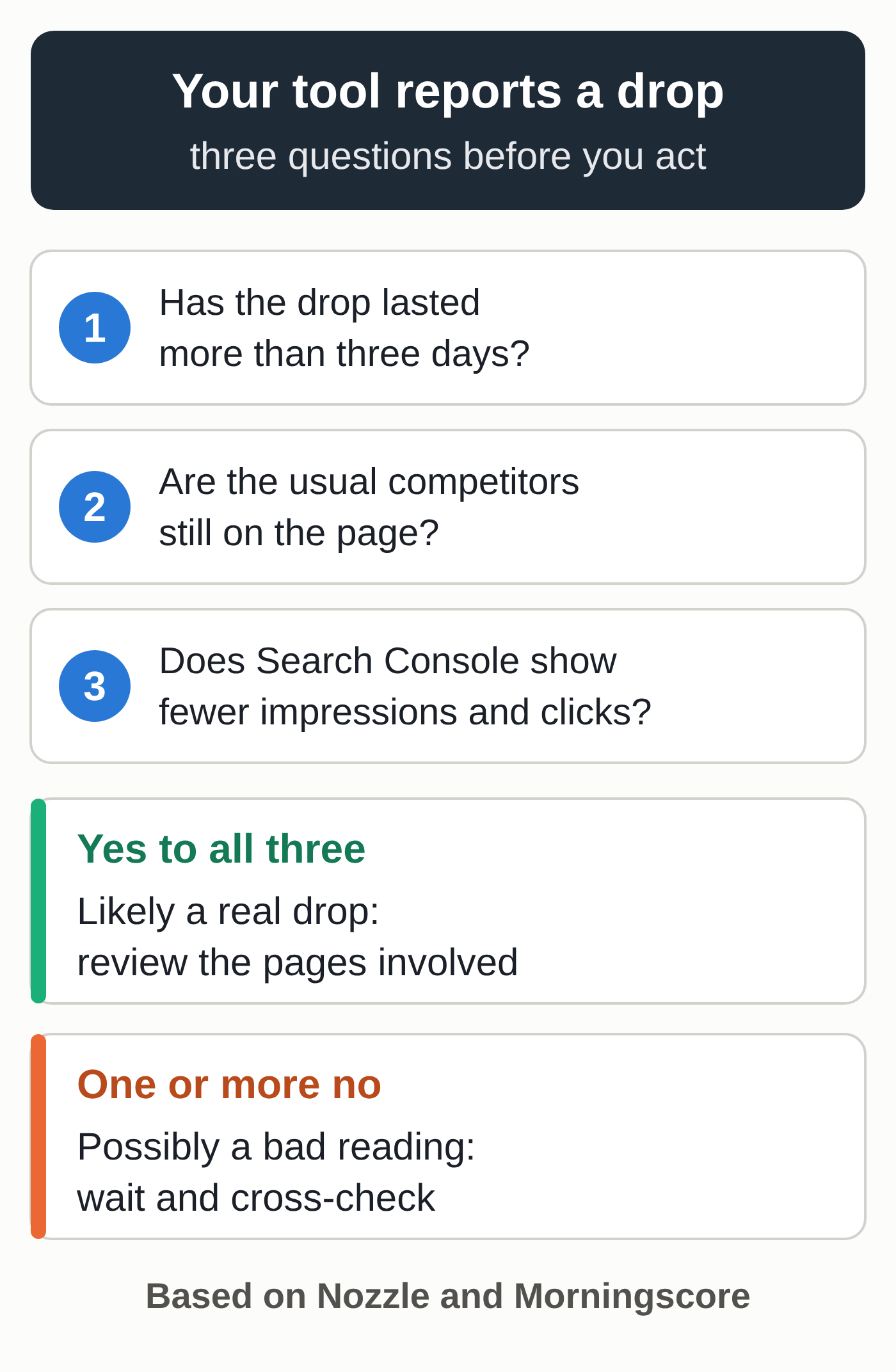
- Compare against the keyword’s history over several weeks rather than just the previous day, which may have been poisoned too, Nozzle warns.
- Wait two or three days. In the study, 77.9% of poisoned pages had their usual sites back within three days. A real ranking change sticks.
- Look at your keywords as a group. When many drop and come back together, Morningscore reads that as a data problem and advises against changing your pages.
- Cross-check in Search Console. According to Nozzle, if impressions and clicks hold steady, the site didn’t really drop. Filter the queries involved with our regular expressions for Search Console, and watch the trend rather than one day’s average position, as Advanced Web Ranking advises.
- Ask your tool’s vendor or your agency how they handle suspicious pages, and whether they’ve corrected the late-September data. Be wary of an agency that panics over a one-day drop without checking it. Our guide to spotting a bad SEO agency covers other warning signs.
- In your reports, mark the period that began on September 13 and leave it open-ended for now. On October 9, the last day Nozzle measured, the poisoned-page rate was still well above its August level.
Open questions
Google hasn’t confirmed anything. The idea of deliberate “poisoning” is the vendors’ interpretation: Nozzle sees it as Google’s response to AI bots that pull from its results, and SEO tools get caught in it. DemandSphere CEO Ray Grieselhuber, quoted by PPC Land, had already attributed Google’s crackdown to the same motive.
The numbers come from companies that sell rank trackers themselves, and each measures in its own way: 8.0% at Nozzle, about 11% at DemandSphere, which doesn’t detail its method. Nozzle’s data stops on October 9, and the study notes that the last three days are still incomplete.
Google doesn’t allow this kind of scraping. Its spam policies list “scraping results for rank-checking purposes” as machine-generated traffic and state that such activities violate those policies and the Google Terms of Service.
Three things are worth watching in the coming weeks: the poisoned-page rate after October 9, whether vendors start publishing a rate of suspicious results (DemandSphere has said it will add one to its data collection dashboard), and any statement from Google.
If your ranking reports show drops since September and you want to know which ones are real, request our free SEO audit.