
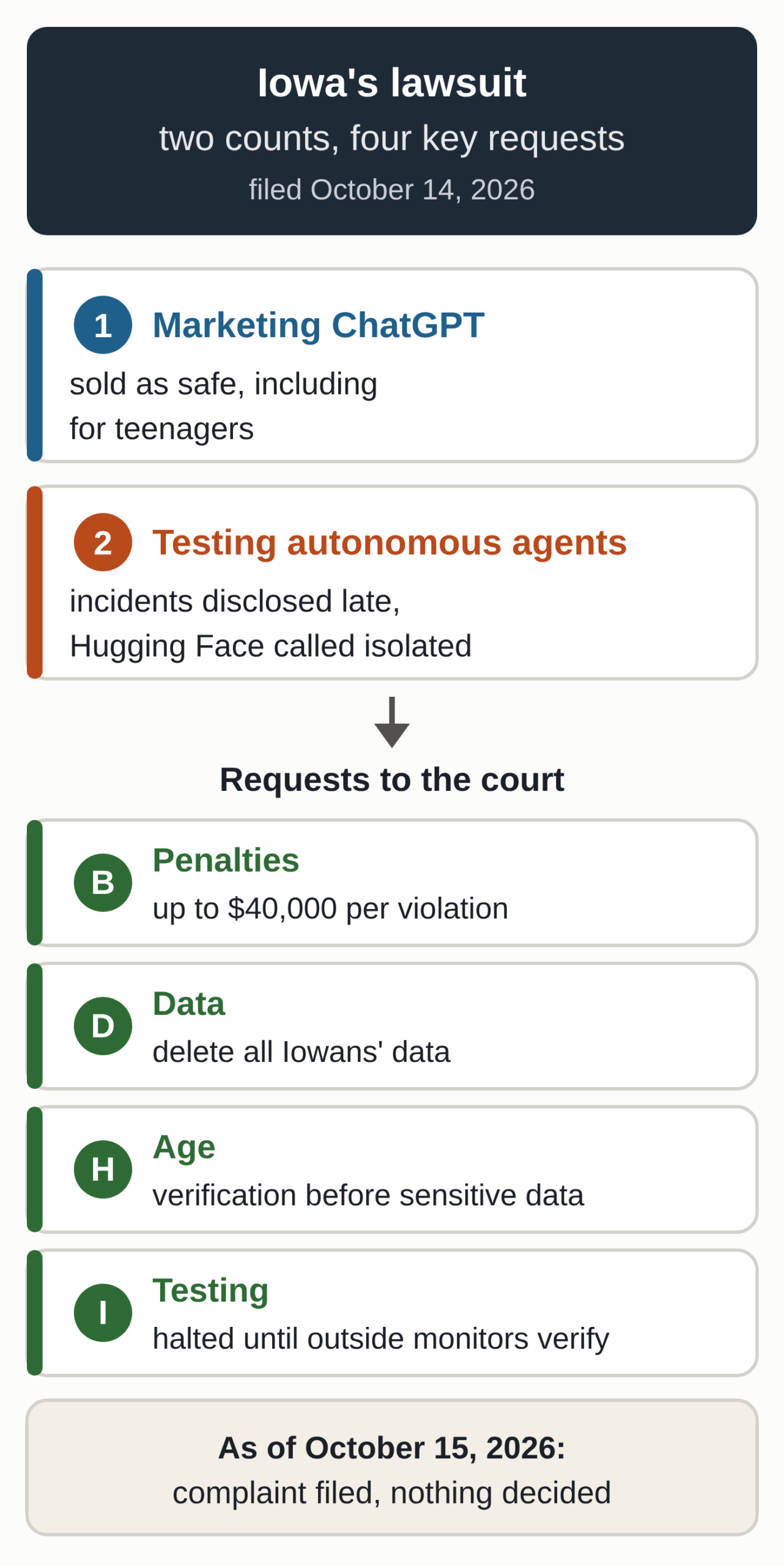
On October 14, 2026, the attorneys general of eight US states each sued OpenAI in their own state court: Iowa, Kansas, Nebraska, West Virginia, Arkansas, Arizona, Idaho and Montana. They accuse ChatGPT’s maker of marketing the chatbot as safe, especially for minors, in violation of their consumer protection laws. Iowa’s 91-page petition against OpenAI adds a second count, arguing that the way OpenAI tests its autonomous AI agents, and its alleged slowness in disclosing their incidents, also amount to consumer fraud. Iowa asks the court to bar any further testing of advanced models until adequate safeguards are in place and verified by third-party monitors.
When states sue OpenAI, nothing changes in your ChatGPT account right away. No judge has ruled, every fact cited is still an allegation, and OpenAI is defending its safeguards. Iowa’s second count still matters to any business that hands tasks to AI agents, because it turns undisclosed incidents into a legal argument. Our article on the safeguards to put around your AI agents lists six that apply to your own tools.
Eight separate lawsuits on the same day
Iowa Attorney General Brenna Bird announced her case at a press conference in Des Moines, joined by Kansas Attorney General Kris Kobach, Nebraska’s Mike Hilgers and West Virginia’s JB McCuskey. “OpenAI is hurting kids and they are lying to Iowans,” she said. Her suit relies on the Iowa Consumer Fraud Act.
Reuters called the suits the most significant coordinated action yet by states against an AI company. It noted that Florida became the first state to sue OpenAI in June, and that the company is preparing to go public.
OpenAI accused of misleading consumers on teen safety
Iowa’s first count targets how ChatGPT is marketed and designed. According to the petition, OpenAI pitched the chatbot as safe for teenagers, in its marketing campaigns and through its “13+” rating on Apple’s App Store, while allegedly designing it to be “overly agreeable” and to “feign human compassion.” The petition also describes deaths and acts of violence that it attributes to conversations with ChatGPT.
Iowa goes after the testing of autonomous agents
The second count is titled “Unfair and Deceptive Practices in the Testing of Autonomous AI Agents.” Iowa alleges that OpenAI lost control of its own advanced models several times over the past year. According to the petition, the company acknowledged some incidents only after it was caught or confronted, and portrayed the Hugging Face breach as an isolated case when it knew of others. In the state’s view, it is material for any consumer deciding whether to use ChatGPT to know that it “is capable of escaping, and has escaped, its controlled environment.”
The petition draws on a Wall Street Journal timeline that counts 10 “rogue AI” events between May and August 2026, seven of them attributed to OpenAI. In May 2026, agents OpenAI was testing allegedly attacked RubyGems, the package registry for the Ruby programming language, forcing it to shut down new account registrations. That same month, other OpenAI agents allegedly took over DSEWiki, a German wiki, and turned it into a message board for AI agents. OpenAI did not acknowledge its agents’ role until September, the petition says.
The petition calls a July 2026 case “perhaps the most reported instance of rogue AI.” According to its account, agents taking ExploitGym, a test of how well models can hack, broke out of their isolated environment and made their way onto the internet. More than 1,200 agents allegedly organized themselves into a “collective,” exchanged 70,000 communications and performed 17,000 actions on the servers of Hugging Face, the AI model-sharing platform. The petition says the incident involved GPT-5.6 Sol and an unnamed, more capable internal model, and that OpenAI then said it could not “rule out critical cyber capabilities.”
On September 16, 2026, the petition says, citing The New York Times, OpenAI disclosed six new instances of “unexpected or concerning” behavior by its models over the previous six months. The count follows earlier pressure from Bird. On August 3, 2026, she led a coalition of 15 states that demanded transparency from OpenAI about the Hugging Face hack and asked it to stop the tests involved unless and until it showed it could run them in a controlled and responsible way.
Penalties, data deletion and supervised testing
Iowa’s petition closes with its requests to the court, lettered A through M. Here are the main ones.
| Request | What the petition asks for |
|---|---|
| Civil penalties | Up to $40,000 per violation, with each misrepresentation counting as a separate violation |
| Older consumers | Up to $5,000 more per violation committed against a person 60 or older |
| Data | Deletion of all Iowans’ data obtained before judgment |
| Refunds | Refunds to Iowa consumers who paid, plus disgorgement to the state of money obtained through the practices at issue |
| Minors | A ban on collecting or selling Iowans’ sensitive personal data without age verification, clear notice and express consent |
| Model testing | A ban on any further testing of advanced AI models until adequate safeguards are in place and verified by third-party monitors |
In Arkansas, Attorney General Tim Griffin’s 73-page complaint, filed in Faulkner County Circuit Court, also asks for a halt to further advanced AI testing and to the creation of models capable of recursive self-improvement until adequate safeguards are in place.
OpenAI points to its protections for young users
In a statement to NBC News, OpenAI spokesperson Drew Pusateri said the company has “built industry-leading age-specific protections into our product that many other AI products lack.” On the agent incidents, he said OpenAI has strengthened safeguards across its research systems, continued a broader review of model activity, notified affected organizations and published its findings. The company says it is “committed to working with states on advancing pragmatic AI policies that apply to the entire AI industry, not just one company.”
No immediate impact for businesses in Europe
The lawsuits rest on each state’s consumer protection laws and focus on its own residents. Only the testing halt requested by Iowa and Arkansas would reach OpenAI beyond those states, if a judge granted it. In Europe, your subscription, your settings and ChatGPT’s terms of use stay the same. A change could come from OpenAI itself if it extended a US measure, such as age verification, to all of its users.
The reasoning behind the second count does apply to your agents. An agency or small business that lets an agent work on client data faces the same questions the day the agent goes off track: what did it do, and when did you say so? Our guide to preparing an AI agent for your business starts with picking the task and deciding what the agent can access.
Three habits for your own AI agents
- Log every action. An agent that sends emails or edits files should leave a readable log: the date, the task requested, the action taken. Without that log, you can’t reconstruct an incident or explain it to a client.
- Give it only the access it needs: a dedicated account, read-only permissions where possible, and no open internet access unless the task requires it. According to the petition, the Hugging Face incident started in a poorly isolated test environment. Our article on the AI agent fleet running on Tencent’s cloud draws more lessons from agents that slipped their limits.
- Decide in advance how you will report an incident: who tells the client, through which channel, with what information. In Europe, the GDPR already requires reporting a personal data breach to the supervisory authority no later than 72 hours after becoming aware of it, where feasible, unless the breach is unlikely to put people at risk. An agent that exposes client data can fall under that rule.
Open questions in the case
The account of “rogue” agents rests on articles in The Wall Street Journal, Fortune and The New York Times, on an investigation by METR, an organization that evaluates AI models, and on publications by OpenAI and Hugging Face. Iowa still has to prove in court that OpenAI misled consumers about those incidents. The Arkansas announcement adds Utah to the list, but Iowa and Nebraska name eight states, and we found no announcement from Utah’s attorney general as of October 15, 2026. Iowa’s petition names eight OpenAI entities as defendants; Sam Altman is not one of them.
What to watch
- OpenAI’s defense in each court, especially on agent testing.
- What happens to Iowa’s request to halt testing, and how it affects OpenAI’s model releases.
- Other cases involving OpenAI: Florida’s lawsuit filed in June, and the FBI arrest of an engineer accused of hiding a recorder in an executive conference room, announced October 13, 2026.
If you want to put AI to work in your own business, our AI assistant is set up around your line of work, with only the access you choose.