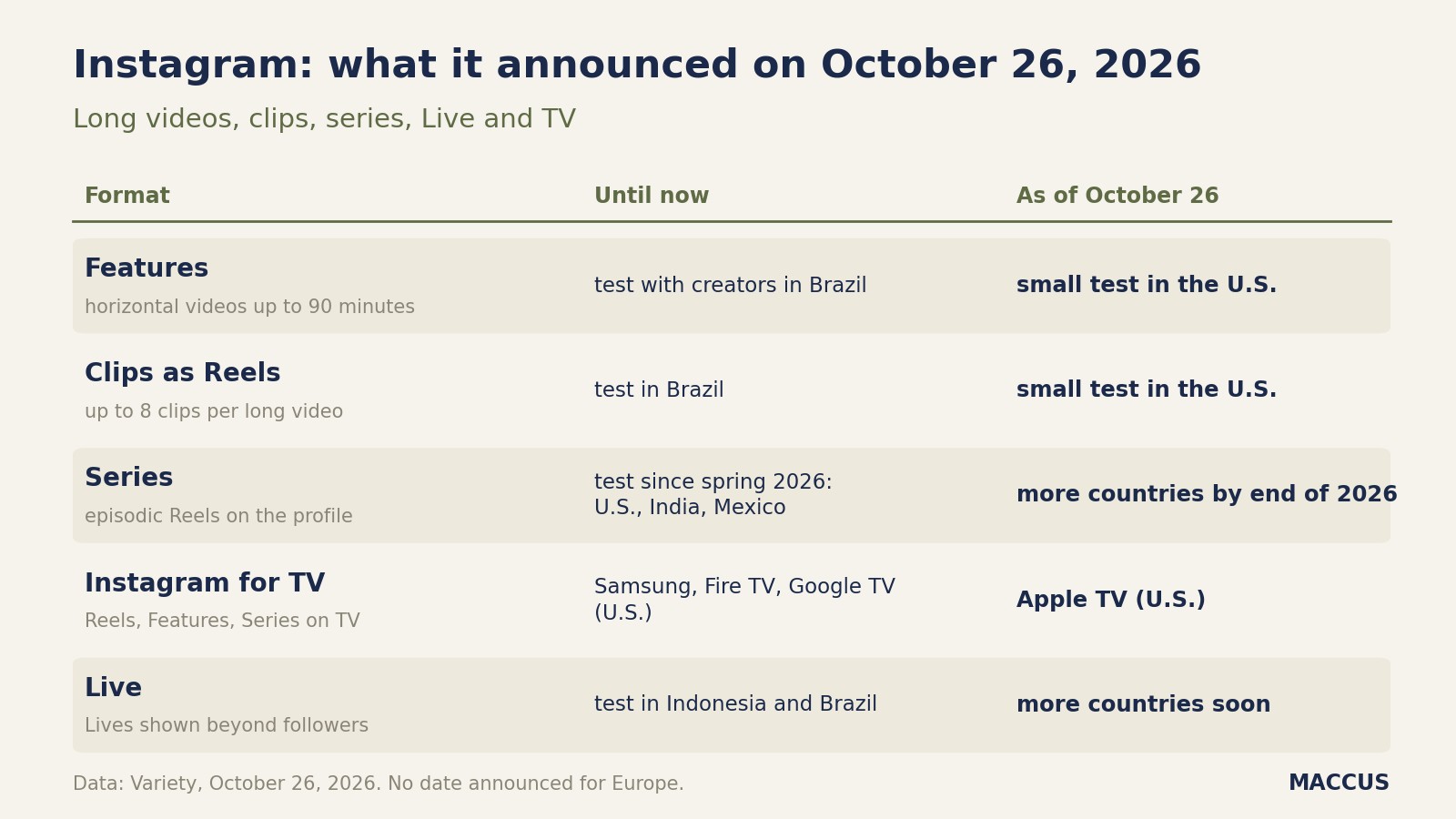

Instagram is testing a horizontal video format that runs up to 90 minutes. Called Features, it was introduced on Monday, October 26, 2026, by Instagram head Adam Mosseri and VP of product Tessa Lyons in a video posted on the platform. The test, already running in Brazil, is expanding to a small group of creators in the U.S. Instagram has not announced a date for Europe.
In the video, Mosseri admits he was against long-form video on Instagram for a long time. The announcement bundles several tests: Reels that link to the full video, episodic series on creator profiles and Lives shown to people who don’t follow the creator. Instagram is also launching its app on Apple TV in the U.S. So far, it has not announced any YouTube-style ad revenue sharing with creators.
Long videos tied to Reels
According to The Hollywood Reporter, Features is aimed at podcasters, comedians and other long-form creators, and the videos will be recommended on the Explore page and elsewhere in the app. Ninety minutes is only one of several length limits Instagram is testing, Variety reports.
The format is paired with a second test called Clips as Reels. A creator posts clips from a long video as Reels, and each clip links back to the full video. Up to eight clips can point to one long video, according to Variety. “You see a clip of a podcast that you love, you can just click and continue watching or watch the full video,” Lyons said, as quoted by The Hollywood Reporter.
The Hollywood Reporter names podcast host Emma Grede, a co-founder of Skims, among the first creators in the U.S. test. The magazine says Instagram plans to expand the test to tens of thousands of creators in the country.
Series, Live and TV
Instagram is also testing Series, a section of the creator profile that collects episodic Reels. Variety says select creators in the U.S., India and Mexico have had the format since spring 2026, and that it will expand to more countries by the end of the year. The Hollywood Reporter gives a different timeline: more countries in the coming months, and the U.S. by the end of this year or early 2027.
Instagram wants to show Lives in the Reels tab as well, to people who don’t follow the creator. That test is starting in Indonesia and Brazil and is due to reach the U.S. next year, according to The Hollywood Reporter.
Instagram’s TV app, launched last year, runs on Samsung, Fire TV and Google TV devices in the U.S. It is now available on Apple TV there too. According to Variety, a feature that turns the phone into a remote is coming soon, along with a way to save videos on mobile and watch them later on TV. “We think the best viewing experience for longform horizontal content is on a big, horizontal screen,” Lyons said, according to The Hollywood Reporter.
Mosseri’s change of heart
“For a long time, I have been against doing long-form video on Instagram,” Mosseri said in the announcement video, as quoted by TechCrunch. He worried that Instagram would end up being only about entertainment, at the expense of connecting with friends, Variety reports. “If you watch a video [on Instagram] for 10 or 20 or 30 minutes, it’s a lot of Reels, photos and carousels that you might not have sent to a friend,” he said. According to TechCrunch, Lyons, who had been pushing for the change, finally convinced him to give long form another shot.
“Reels is still going to be a core part of Instagram,” Lyons said in the video. Mosseri said he wants short-form and long-form video to be “symbiotic.” He warned that the TV experience would “take some time to get right” but said the company is “very committed to it long term.”
Instagram has tried this before. In 2018, it launched IGTV, a separate app for longer videos. The app never gained much traction and was shut down in 2022, Engadget notes.
Creator pay is still unclear
On YouTube, creators in the Partner Program get 55% of the ad revenue YouTube earns from their videos, TechCrunch points out. Instagram offers no equivalent share. “It’s too early to share a long-term monetization model, but we’re exploring ways for creators to earn from brands, fans, and Instagram, including performance-based incentives,” a Meta spokesperson told TechCrunch.
For now, Instagram is funding some long-form creators directly, according to an Instagram representative quoted by Variety. Lyons said the company is working on “a few different deals” with the early participants and that there is currently no exclusivity, according to The Hollywood Reporter. Creators can bring their existing brand deals into the videos, and Instagram will help creators without sponsors find deals, the magazine adds.
Mosseri described the limits of the current model on the Colin and Samir Show, TechCrunch reports. On Instagram, he said, creators mostly get paid by brands, and the platform’s small performance-based program loses money: “we spend more money than we make back by a long shot.” In the comments on the announcement video, users asked why they should post long videos on Instagram when YouTube pays creators for the same thing, 9to5Google noted.
A test with no numbers and no timeline
In the caption of his video, quoted by 9to5Google, Mosseri frames the announcement as a starting point: “It’s early, and we’re testing and listening to feedback as we go.” No results from the Brazil test had been made public as of October 26: no audience figures, no watch time, no number of participating creators. The criteria for joining the U.S. test are not public, and at this point only a few creators who have struck individual deals with Meta can post these videos, according to Engadget. The 90-minute limit itself is not final.
U.S. outlets give different timelines for Series, and none cites a date for Europe. The announcement video could not be viewed outside the U.S. on the day it was posted, 9to5Google found. TechCrunch says it is possible Meta will put ads in these long videos, but the company has not announced any such plan.
What it means
With Features, Instagram is walking back a position its head held for years. Unlike IGTV, which relied on a separate app, Features lives inside the main app, and clips posted as Reels point viewers to the full episode.
Instagram is trying to hold on to viewers who now leave for YouTube. According to TechCrunch, many creators treat their Instagram and TikTok accounts as promotional arms for their YouTube channels.
The change matters first to long-form creators (podcasts, interviews, comedy specials) and the brands that sponsor them. For creators in Europe, nothing changes yet, since the Features test is limited to Brazil and the U.S. Instagram is not the only platform testing new features outside Europe: in mid-October, LinkedIn’s money-making features, including selling advice from a profile, were also still limited to the U.S.
Instagram has shown little so far: a format, a length cap still being tested and a few creator names. It is pitching reach, with videos recommended on the Explore page and elsewhere in the app, where Instagram’s algorithm already surfaces posts from accounts people don’t follow.
Pay is still undecided, while YouTube shares 55% of ad revenue with creators in its Partner Program. Meta makes most of its money from advertising, and its average price per ad rose 14% year over year in the third quarter. The company has not said whether ads will run in long videos.
Creator analytics are another unknown. Instagram has not explained how it will count watch time on a 90-minute video, or how these videos will rank against Reels.
Three things to watch: whether the Instagram long-form video test expands beyond Brazil and the U.S. (and gets a date for Europe), the pay model Meta says it is studying, and whether ads show up in Features videos. IGTV showed that Instagram can also shut down a long-form format that fails to find an audience.
Sources
- Features announcement video, with Tessa Lyons, Instagram (Adam Mosseri’s account), October 26, 2026
- Instagram Tests 90-Minute Horizontal Videos in Major Play for Podcasters and Creators, The Hollywood Reporter, October 26, 2026
- Instagram Is Testing Ability to Share Videos up to 90 Minutes Long and Launches on Apple TV, but Unlike YouTube, It’s Still Not Paying Creators a Share of Ad Revenue, Variety, October 26, 2026
- Watch out, YouTube: Instagram goes from short-form to 90-minute videos, TechCrunch, October 26, 2026
- Instagram tests ‘Features’ long-form videos, but missing YouTube’s ad share for now, 9to5Google, October 26, 2026
- Instagram wants you to watch 90-minute videos on your TV, Engadget, October 26, 2026
Header image: MACCUS chart, data from Variety, October 26, 2026