
On October 27, 2026, Semrush published a blog post about “poisoned SERPs”: some automated search requests may get Google results pages that look normal but differ from what a typical user would see. The company describes it as an industry-wide problem for SEO data providers. Five days earlier, on October 22, Ahrefs said it was seeing 5% to 20% of search results affected, depending on the data provider.
The two all-in-one SEO platforms join the rank-tracking vendors that have been raising the alarm since September, including Nozzle, whose study we covered in our October 14 article on distorted rank tracking. Google hasn’t commented publicly, Semrush notes.
Semrush and Ahrefs, five days apart
Semrush describes two kinds of poisoned pages. Either the whole results page is clearly off, with results that don’t match the query even on page one, or the page looks normal at first and then, further down, lists pages that only loosely match the search. In one example from Brazil, a search for a specific stroller model returned a dental supply store’s equipment page, because both products share the Portuguese word “carrinho.”
Semrush says it excludes clearly invalid results during collection, has adjusted its data sources and has added validation checks that flag questionable results for re-collection. It advises users who see unexpected ranking changes, especially for keywords unrelated to their pages, to compare them against their own data, such as Google Search Console. In an earlier statement to Search Engine Roundtable, the company said it had been seeing the issue “since late summer,” with a “limited” impact on the rankings its users track: individual cases, most often beyond the first page of results.
Ahrefs’ post, published October 22 on its product blog, reports a rise over the past few weeks in Google “poisoning” search results, with suspected SERP data providers shown different pages. Ahrefs says it filters out abnormal results, requests accurate replacements and is cleaning up past results that may have been affected. The post gives no methodology, sample size or start date. According to PPC Land, Ahrefs is the first vendor in its coverage to say it is going back over data it has already stored.
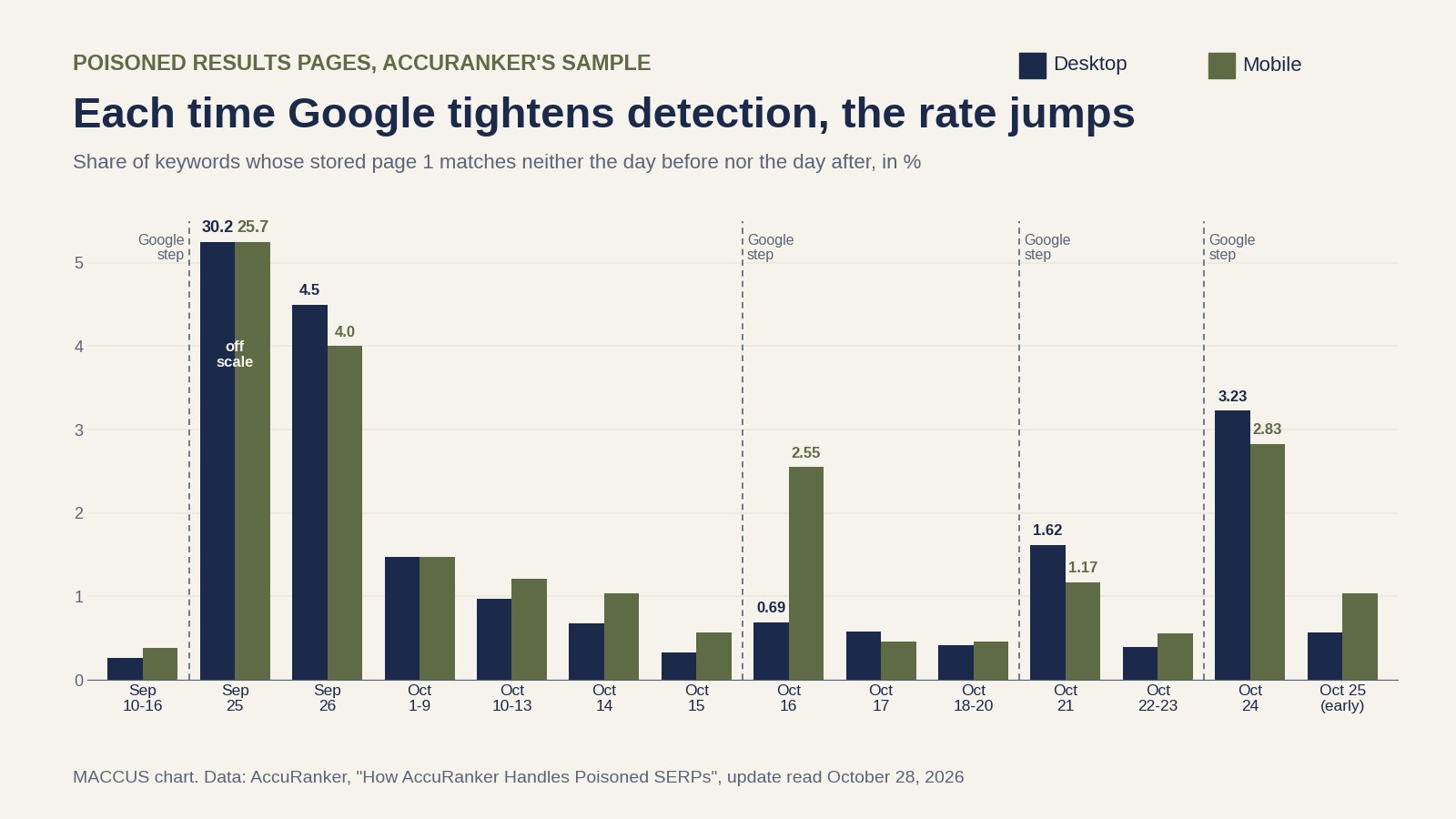
AccuRanker says Google tightened detection again on October 20 and 23
AccuRanker, another rank-tracking company, has been updating a detailed analysis it first published October 19. By its account, Google appears to decide session by session, regardless of the keyword, whether to serve a poisoned page: two identical searches run at the same time can get different pages.
After the late-September wave, Google tightened its detection on October 15, mostly on mobile, then again on October 20 and October 23. Late on October 20, within an hour, about half of AccuRanker’s first desktop fetches came back poisoned. The October 23 step was broader and hit both desktop and mobile: on October 24, 40% of its first desktop fetches got a poisoned page.
Its checks kept most of them out, but that day 3.2% of the desktop keywords in its sample still had a swapped page 1 in its stored data, the highest level since September 26. According to AccuRanker, the October 23 step has not fully gone away: Google still poisons 4% to 6.5% of its first fetches, compared with 1.6% to 3.3% before then. Cut-down pages, where results stop after one or two pages, have doubled to 4.0% of its desktop requests.
Nozzle updated its study on October 21, covering 29.9 million results pages. Its desktop measure now counts a search as poisoned when page 1 or page 2 is, and puts the rate at 22.6% since September 13, compared with 0.28% before, with a peak of 43.5% on September 30. After easing to 4% to 6% on October 14 and 15, the rate climbed back to 25.9% on October 19 and 35.7% on October 21, the worst day since October 8. Page 2 is poisoned one and a half times as often as page 1.
DemandSphere, which announced new countermeasures on October 23, found that 6.7% of the pages it collected that day were poisoned.
| Vendor | Published | Reported figure |
|---|---|---|
| AccuRanker | October 19, updated since | 40% of first desktop fetches poisoned on October 24, 3.2% of keywords after checks |
| Nozzle | updated October 21 | 22.6% of desktop searches (page 1 or 2) since September 13, 35.7% on October 21 |
| Ahrefs | October 22 | 5% to 20% of results, depending on the data provider |
| DemandSphere | October 23 | 6.7% of pages collected that day |
| Semrush | October 27 | no rate published |
Belgium is still among the hardest-hit countries
In Nozzle’s country table, limited to page 1 and running through October 21, 15.9% of the 346,115 Belgian pages judged were poisoned. The first version, which we covered on October 14, put Belgium at 13.2%, but it stopped on October 9 and only counted pages whose usual sites came back later. France is at 5.3% (3.9% in the first version), far below Austria (21.0%) and Switzerland (16.1%), and the United Kingdom remains the least affected, at 4.1%.
Nozzle doesn’t explain the gaps between neighboring countries. AccuRanker sees no market, device or keyword type that stands out: from late September to mid-October, the share of poisoned pages stayed between 1.1% and 1.7% in each of the 22 markets it tracks.
Each vendor measures differently
These rates come from companies that sell rank-tracking tools themselves, and each one tests its own data collection its own way. AccuRanker counts a page 1 as poisoned when its top 10 keeps fewer than half of the sites from the day before and fewer than half from the day after. Nozzle compares each page with the sites the keyword usually showed between August 20 and September 9. AccuRanker says the rate depends more on how the data is collected than on which keywords are tracked.
Google’s motive is still a matter of interpretation. Semrush writes that industry discussion, including Search Engine Roundtable’s coverage, suggests a likely driver is the effort to limit large-scale data collection for AI systems. Nozzle calls it Google’s response to AI scraping, with rank trackers caught in it. Google has confirmed nothing, but its spam policies list “scraping results for rank-checking purposes” under machine-generated traffic, which violates those policies and Google’s Terms of Service.
On October 27, Barry Schwartz of Search Engine Roundtable reported a spike in volatility and SEO chatter, following earlier unconfirmed shifts on October 16, 20, 21 and 24. He added that the tracking tools “are struggling,” despite what some vendors have said in statements. The volatility charts he cites come from those same tools. The same day, an SEO on Reddit described average visibility falling from 30% to 12% in Semrush and Botify, though Google had confirmed no update.
The September 2026 spam update rolled out from September 24 to October 8, on top of the first poisoned pages, and that overlap made its effects harder to measure, as we reported in our October 12 article on Search Console delays and rank trackers.
What it means
Until mid-October, the warnings came mostly from rank-tracking specialists. Ahrefs and Semrush now acknowledge in their own posts that their Google data can be distorted. Nozzle’s measured rates and the share of AccuRanker’s first fetches that came back poisoned both rose again in the second half of October.
Rank reports, visibility indexes and volatility charts from third-party tools all rely on this kind of collection. A sharp one-day drop, especially on October 16, 21 or 24, the dates AccuRanker cites, can reflect a page Google served only to a bot. With the retroactive cleanup Ahrefs announced, a chart exported in October may also no longer match the same chart viewed later.
Vendors say they filter out most poisoned pages, but only AccuRanker publishes a daily figure for what is left in its stored data after its checks. As PPC Land points out, Search Console, which Semrush offers as a benchmark, covers only sites whose ownership has been verified, so competitor rankings and market-level visibility still come from the automated collection Google is degrading.
Google’s actual goal, how long this will last and how much data each vendor has already corrected remain unknown. The next signals would be a statement from Google, error rates from Semrush and Ahrefs for their own data, which neither has published so far, and whether the October 27 movement gets confirmed.
Sources
- Poisoned SERPs: An update on Google ranking data in Semrush, Semrush, October 27, 2026
- An update on Google’s poisoning of search results, Ahrefs, October 22, 2026
- How AccuRanker Handles Poisoned SERPs, AccuRanker, October 19, 2026, updated since
- Poisoned Google SERPs, Nozzle, October 10, 2026, updated October 21, 2026
- How we detect poisoned SERPs, DemandSphere, October 23, 2026
- Unconfirmed Google Search Ranking Update: Volatility & Chatter Spike, Search Engine Roundtable, October 27, 2026
- Third-Party Google Rank Tracking Not Fully Working Now, Search Engine Roundtable, October 12, 2026, updated since
- Spam Policies for Google Web Search, Google Search Central, August 28, 2026
Header image: MACCUS chart. Data: AccuRanker, “How AccuRanker Handles Poisoned SERPs”, update read October 28, 2026