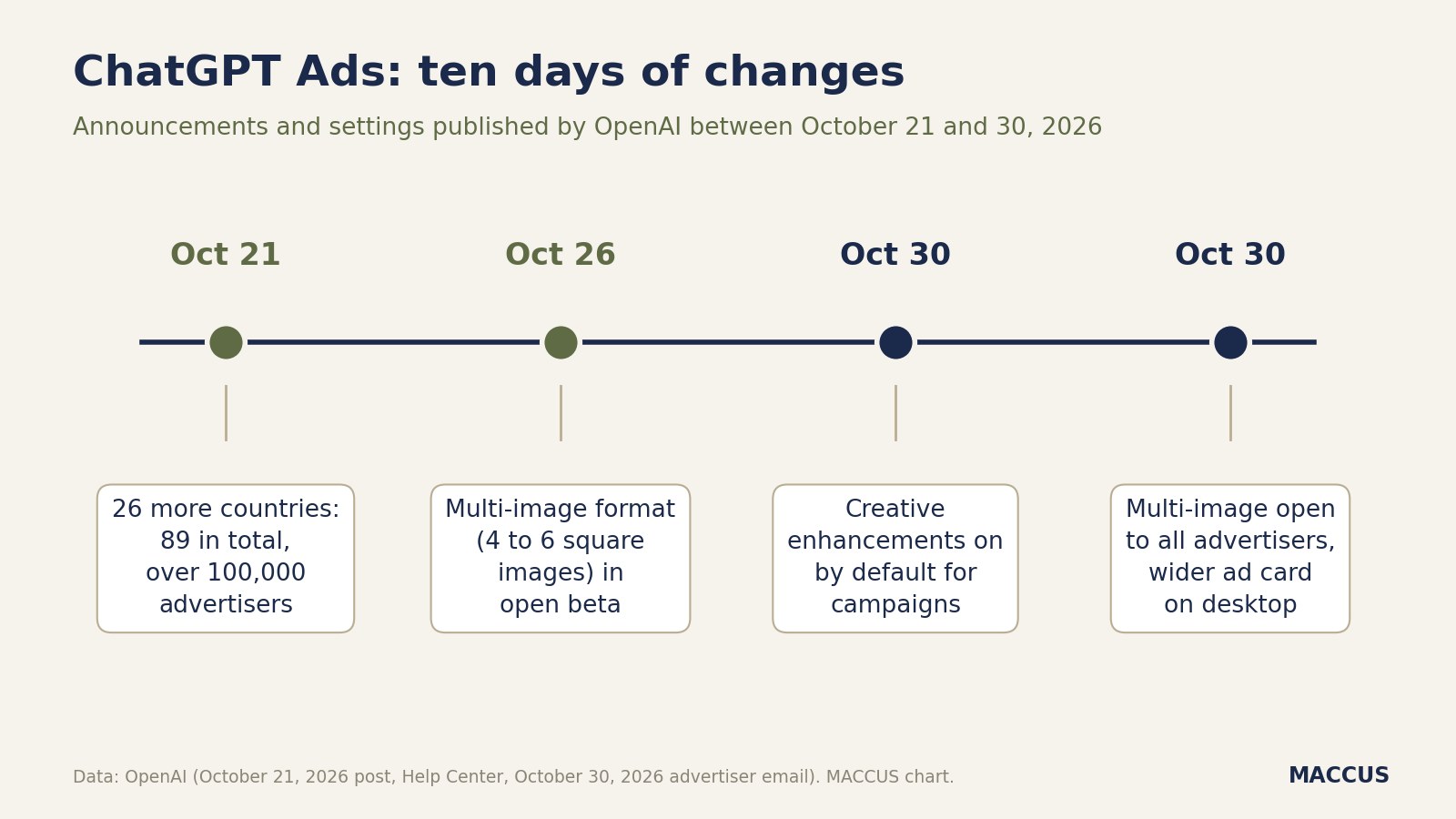

As of Friday, October 30, 2026, OpenAI’s ad system can modify ChatGPT ads on its own: rewrite headlines and descriptions, translate the copy, resize images and send users to a different page on the advertiser’s site. OpenAI’s Help Center, in both English and French, says these “creative enhancements” are on by default for new and existing campaigns unless the advertiser has opted out.
The same week, OpenAI opened its multi-image ad format to all advertisers and began rolling out a wider ad card on desktop. The company announced both in its weekly email to advertisers, which Search Engine Roundtable published on October 30.
October 30 is now the only start date
On October 21, maccus.fr flagged two different start dates for creative enhancements: Thursday, October 29 on OpenAI’s help page and Friday, October 30 in the email sent to advertisers. The help page now matches the email: “Starting Friday, October 30, 2026, creative enhancements will be enabled automatically for new and existing campaigns.” Search Engine Journal reported the same date from the English page on October 30.
The page says that opt-outs already saved at the account or campaign level stay in place and that a campaign’s setting overrides the account default. Advertisers can change their minds at any time in Ads Manager by selecting “Manage settings.”
The page describes a single setting, with no separate control for text, translation, images or the destination URL, Search Engine Journal noted. Going by that description, advertisers either accept all four types of changes or turn them all off.
Text in September, images and links in October
As Search Engine Journal pointed out, OpenAI announced AI customization of ad text on September 16 and presented it as an opt-in feature. That feature tailors headlines and descriptions to the conversation and translates the copy into the user’s language. Creative enhancements add image resizing and destination URL changes, and the outlet observed that the help page does not explain how the two features relate. It also cited an October 21 OpenAI engineering post saying the system writes a short introduction for every ad, separate from the headline, description and link the advertiser supplies.
Variations can be prepared in advance or generated in real time during the conversation. To build them, the system can draw on the existing ad, the content of its landing page and the context of the conversation or the user’s interests. In its FAQ, OpenAI says advertisers do not need to approve each version before it runs and that the feature does not provide a preview of every variation.
Four to six images, one link
The multi-image format arrived in Ads Manager on Monday, October 26, 2026, as an open beta, according to the “Creating ads for ChatGPT Ads” help page. When creating an ad, advertisers choose “Single image” or “Multiple images.” The second option takes four to six square images with a 1:1 aspect ratio.
Every image is clickable and leads to the same destination URL. “Learn more” is the only button on offer for now. Both formats work with standard campaigns that use the Reach, Clicks or Conversions objective, under the same headline and description rules.
OpenAI’s October 30 email describes the format as available to all advertisers as an open beta. Neither the ad creation page nor the creative enhancements page says whether the automatic changes also apply to multi-image ads, Search Engine Journal noted.
A wider card on desktop
The same email introduces a new, wider standard ad card that takes up more of the conversation’s width on desktop. It uses existing campaigns and creative, so advertisers don’t need to do anything, OpenAI said.
89 countries, including France and Belgium
The October 30 email also repeats older news. On October 21, OpenAI expanded ChatGPT Ads to 26 more countries, bringing the total to 89, and said more than 100,000 advertisers had run campaigns since ads debuted just over eight months earlier. According to the Help Center, ads may appear for users on the Free and Go plans, while Plus, Pro, Business, Enterprise and Edu accounts stay ad-free.
OpenAI’s “Ads Manager Availability” page lists France, Belgium, Luxembourg and Switzerland among the countries where businesses can buy ChatGPT ads themselves, an option that opened in Europe on August 31. Personalized ads, which draw on signals from a user’s broader use of ChatGPT beyond the current chat, “are not initially available in the European Economic Area (EEA) or Switzerland,” OpenAI writes.
Blind spots in measurement
OpenAI bills creative enhancements as a way to make ads more relevant and help them perform better, but it has published no figures to back that up. Its own help page warns that Ads Manager metrics describe overall performance and that “changes over time do not, on their own, establish the effect of creative enhancements.”
Reports are still broken down by campaign, ad group and ad. Neither the creative enhancements page nor the “Measure Results” page describes a report that isolates each modified version, Search Engine Journal found. The outlet raised another open question: the creative enhancements page does not say how tracking parameters such as UTM tags carry over when the system changes the destination URL, or whether advertisers can exclude certain pages on their site.
For tracking, Ads Manager accepts URL parameters at the campaign, ad group or ad level, according to the “Measure Results” page. Parameters added directly to the ad’s URL take precedence.
On Reddit, two posts published October 30 in a subreddit for pay-per-click advertisers asked how well ChatGPT Ads performs. In the first, an advertiser who had tried the platform said the results were disappointing for the cost. The second asked whether anyone had conversion data solid enough yet to compare ChatGPT Ads with Google Ads.
What it means
In six weeks, OpenAI went from text customization it presented as optional on September 16 to creative enhancements that are on by default and extend to images and landing pages. The change applies to self-serve advertisers who have not turned the setting off, in every country where Ads Manager is open, France and Belgium included. Without any prior review, an ad written in French can now be reworded, translated or pointed to a different page on the advertiser’s site.
Google and Meta made similar moves in October. Google Ads now turns on adding an advertiser’s online videos to Performance Max by default for all new campaigns, according to the English version of its help page. Meta told advertisers it would add product browsing to their existing ads starting October 28 unless they opted out.
No published measurement supports the benefit OpenAI claims, more relevant and better-performing ads. Advertisers get no preview of each version and, according to the current documentation, no per-version report. Nor does the help page say what happens to an advertiser’s tracking parameters when the landing page changes.
Still to watch: whether OpenAI adds separate controls for text, translation and URLs or a report for each modified version, the rollout schedule for the wider card and whether it comes to mobile, and when personalized ads might reach Europe.
Sources
- Creative enhancements for ChatGPT Ads, OpenAI Help Center, accessed November 1, 2026
- Creating ads for ChatGPT Ads, OpenAI Help Center, accessed November 1, 2026
- Measure Results, OpenAI Help Center, accessed November 1, 2026
- Ads in ChatGPT, OpenAI Help Center, accessed November 1, 2026
- Ads Manager Availability, OpenAI Help Center, accessed November 1, 2026
- ChatGPT Ads expands to 26 new countries as over 100,000 advertisers have used the platform, OpenAI, October 21, 2026
- ChatGPT Gets Wider Ads, Multi-Image Ads Expands, Expansion & More, Search Engine Roundtable, October 30, 2026
- ChatGPT Ads Turns On Automatic Ad Changes By Default, Search Engine Journal, October 30, 2026
Header image: MACCUS chart, data from OpenAI (Help Center, October 21, 2026 post and October 30, 2026 advertiser email)