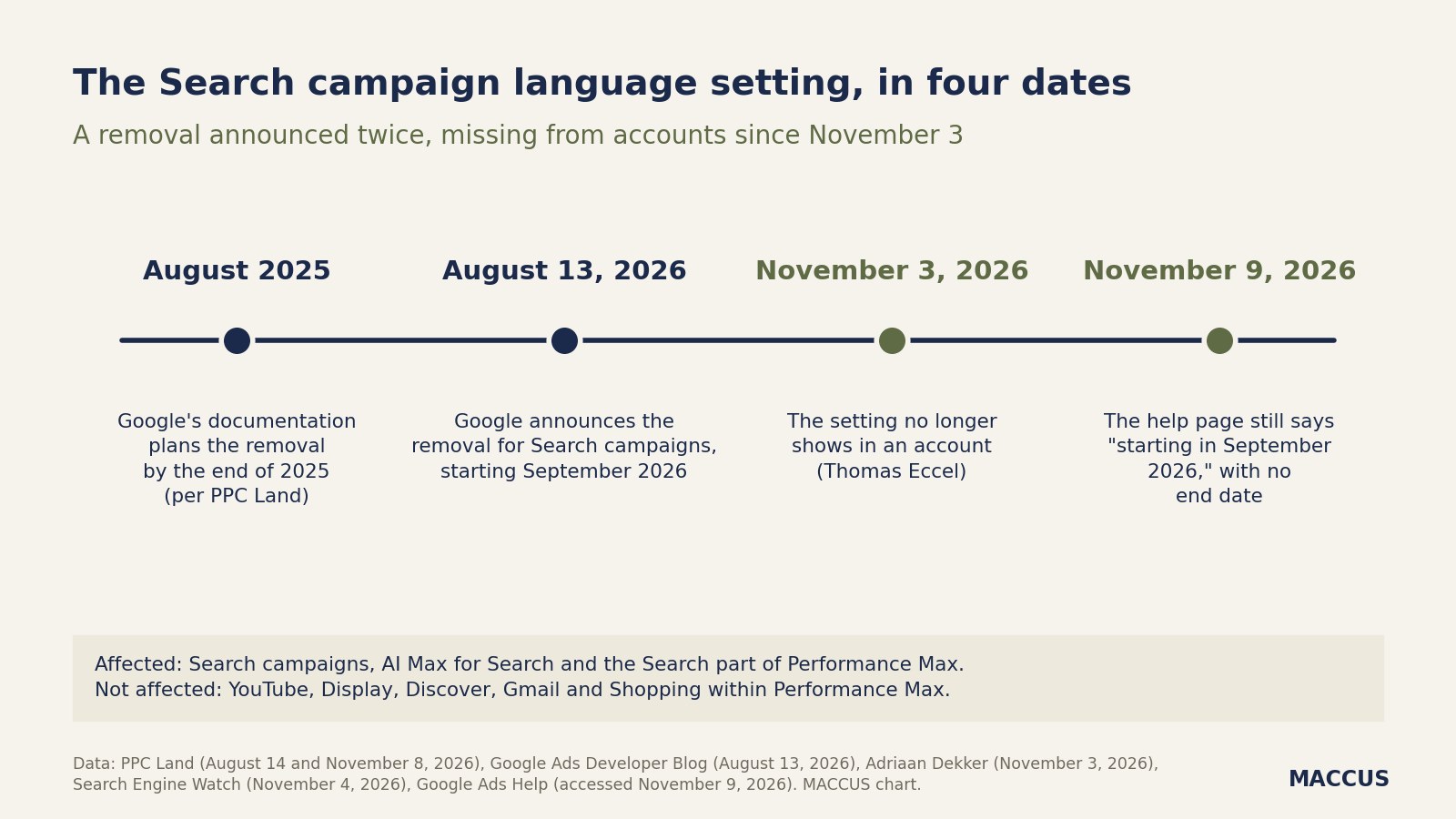

Google has started removing the language targeting setting from Search campaigns in Google Ads, its advertising platform. Search campaigns are the ones that place ads in search results. Until now, the setting let advertisers choose which languages their audience speaks. Without it, Google decides who sees an ad based on the ad’s language and the languages it believes the person understands.
On November 3, 2026, Google Ads specialist Thomas Eccel posted on LinkedIn that he could no longer find the setting in one of the accounts he manages. The next day, the trade site Search Engine Watch reported his finding: the change was live in at least one account.
Google announced the removal on August 13, 2026, with a target date of late September. It applies to all Search campaigns, including those that use AI Max for Search. That option lets Google’s AI broaden targeting and adapt the ad text. The removal also covers the Google Search part of Performance Max, a campaign type that serves ads across all of Google’s ad channels.
A setting missing from some accounts in early November
“I was looking for the language setting but could not find it,” Eccel wrote on November 3. According to the trade site PPC Land, his screenshot shows the settings of a Search campaign with a start date of October 1, 2026. The locations line is still there; the languages line is gone. Google Ads specialist Adriaan Dekker reported the finding on his site the same day.
According to PPC Land, another trade outlet, PPC News Feed, reported on November 4 that Google Ads had “officially removed” the setting for Search campaigns. Search Engine Watch ended its article with a caveat: not every advertiser may see the change yet.
On November 8, PPC Land quoted practitioners who had commented on Eccel’s post. One had not yet seen the change in their accounts. Another said the setting was still available in Google Ads Editor, Google’s desktop app for editing campaigns in bulk.
Google’s reasons and a deadline that slipped
Google made the change official on August 13, 2026, in a post on the Google Ads Developer Blog. The author is Dora Sun of the Google Ads API team; the API is the interface that lets software manage accounts. “For Search and AI Max for Search campaigns, the campaign-level language targeting setting will be removed,” she wrote. She gave “late September 2026” as the effective date.
The next day, Ginny Marvin described the change on LinkedIn. Marvin is Google’s Ads Product Liaison, the company’s go-between with advertisers. According to PPC Land, she wrote that the setting had “become redundant.” She added that Google had “heard a lot of confusion” about how the setting works, which led to setup issues.
Google gave the trade site Search Engine Roundtable the same reasons: it wants to simplify language targeting and eliminate redundancy and setup errors.
According to PPC Land, Google’s documentation said back in August 2025 that the setting would leave Search campaigns by the end of that year. That deadline passed, and Google then set September 2026 as the new date. As of November 9, 2026, Google’s help page still says the change applies “starting in September 2026,” with no word on when every account will have it.
How Google now matches ads to languages
Google’s help page “About language targeting” describes the new system on the Search Network, which covers Google Search and its partner sites. Google Ads looks at the language of the search (the words typed in), the person’s language settings and their preferences. It then tries to show the best available ad in a language that person understands.
Google can judge which languages a person understands from their settings, the languages they regularly interact with and the ones they search in. When a search is clearly in one language, Google favors the ad and the landing page (the page the ad leads to) written in that language. For a search with no clear language, such as a brand name, Google favors the person’s preferred language.
Google gives an example: a user who understands English and Spanish can search in Spanish and be shown an ad in English. The language of the landing page counts too. That brings the setup of a multilingual website and its hreflang tags into play. Hreflang tags are the code that tells Google the language of each version of a page.
Sometimes several campaigns in one account could show an ad for the same search. An AI system then picks the ad group (a set of ads and keywords) whose language seems the best fit.
According to PPC Land, Marvin also listed what is not changing. Google Ads still doesn’t let advertisers exclude a language: leaving a language unchecked doesn’t keep its speakers from seeing an ad. Google doesn’t translate ads either. A separate beta tool, reported in early October, translates Search campaigns into ten languages, but only from English.
Performance Max and the API follow separate rules
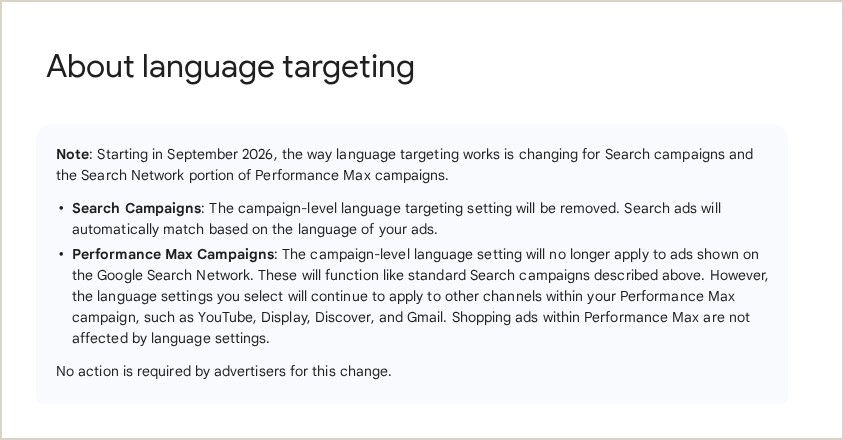
In Performance Max campaigns, the language setting no longer applies to ads shown on Google Search. It still applies to the other channels, such as YouTube, Gmail, the Discover feed in the Google app and banner ads on the Display Network (Google’s partner sites and apps). Shopping ads in Performance Max don’t depend on the setting. Google has also said that Performance Max may hand brand searches to Search campaigns.
The August 13 post also covers software connected to the API. Language settings already saved on a campaign can still be read, but Google no longer uses them for targeting. Adding or changing one on a Search campaign returns an error. On Performance Max, the same request still goes through, because the setting still applies to the other channels there.
Google recommends that developers stop sending these settings for new Search campaigns. It calls removing the old ones optional.
Specialists and agencies react
Eccel and Dekker sum up the change the same way: the ad text and the landing page now decide who sees the ad. Both advise against mixing languages within one ad group. They still see value in running one campaign per language, because it keeps budgets and reporting separate.
On September 6, Make Sense, an agency with an office in Montreal, analyzed the issue for Quebec accounts. “In the Quebec accounts we take over, the language setting was rarely used to filter an audience,” founder Maxence Vanderswalmen wrote (our translation). “It was used to partition: one report per language, one budget per language, ads that don’t mix.”
The agency notes that in France, where one language dominates, the removal changes nothing in how an account is structured. At most, it affects volume at the margin. In Quebec, by contrast, the same location targeting can reach both French and English speakers. In accounts that mix keywords from both languages, the agency expects ads to show in the wrong language and clicks to land on a page in the other language.
According to PPC Land, three groups of advertisers have the most at stake: those in multilingual markets, travel and hospitality businesses, and companies that target expatriates.
The site points to two cases raised in the comments. One is an ad that contains brand names in a different language from the rest of the ad. The other, posed as a hypothetical, is a hotel that targets Japan with landing pages only in English and German. PPC Land notes that Google’s documentation doesn’t say how its system would decide in such cases.
Google’s claims and the open questions
“No action is required by advertisers for this change,” Google’s help page says. The same page claims that prioritizing the language of the search “gives you better control to ensure your most relevant creative is served.”
Google has given no end date for the rollout and no figure on how accurately it detects languages. The help page doesn’t mention Google Ads Editor, where a practitioner quoted by PPC Land says the setting is still visible. The published reports come from a handful of accounts, and none yet measures the effect on clicks or costs.
What it means
The change turns language from a filter that advertisers set into a signal that Google interprets. Until now, advertisers checked boxes for the languages they wanted, and Google made sure the person understood one of them. Now advertisers express their language choice through the language of the ad and the landing page. Google infers the rest from the person’s searches, settings and habits.
According to Google, accounts already set up with one language per campaign will keep working as before. The effect should be larger in tourism and in countries where several languages are spoken, such as Belgium (French, Dutch and German), Switzerland, Luxembourg and Canada. In those accounts, the setting could keep two language versions of the same offer from mixing, as Make Sense describes for Quebec.
Google’s timeline only partly matches what has been observed. Google aimed for late September, and the first account without the setting was reported on November 3. The help page promises better control. Advertisers, meanwhile, lose an explicit setting and must rely on language detection whose reliability Google doesn’t publish.
Three things are worth watching: when the help page announces the end of the rollout, what happens to the setting in Google Ads Editor, and whether agencies in bilingual markets report ads shown in the wrong language.
Sources
- About language targeting, Google Ads Help, accessed November 9, 2026
- Google Ads language targeting changes starting September 2026, Google Ads Developer Blog (Dora Sun), August 13, 2026
- Google Ads Language Targeting Update, Search Engine Roundtable (Barry Schwartz), August 14, 2026
- Google Ads drops language targeting in September, nine months past deadline, PPC Land, August 14, 2026
- Cibler le français et l’anglais dans un compte Google Ads québécois, sans le paramètre de langue, Make Sense, September 6, 2026
- The language setting is gone from Google Ads Search campaigns, Adriaan Dekker, November 3, 2026
- Google Ads removes campaign-level language targeting from Search campaigns, Search Engine Watch, November 4, 2026
- Google Ads drops language targeting from Search campaigns, PPC Land, November 8, 2026
Header image: MACCUS chart, data from Google (Google Ads Developer Blog, August 13, 2026; Google Ads Help, accessed November 9, 2026), PPC Land, Adriaan Dekker and Search Engine Watch