Indian AI company Sarvam AI released Sarvam-105B-1711, a new version of its Sarvam 105B model, on November 22, 2026. The release adds a compressed version that takes up 65 GB, compared with 198 GB for the full version, according to Sarvam. The company says the compressed build runs on a single workstation graphics card, fully offline, for work on confidential documents.
Sarvam-105B-1711 is an open model: its weights, the files that make up the model, can be downloaded under the Apache 2.0 license, which allows commercial use. Sarvam, a Bengaluru company founded in 2023, is targeting banks, government departments and what it calls strategic sectors. Those organizations could run the model on their own machines instead of sending their documents to an outside service. The company also reports that the new version scores much higher than the one released in February 2026, in tests it ran itself.
A 65 GB version that fits on one card
Sarvam 105B has 105 billion parameters, the internal settings a model learns during training. It uses a “mixture of experts” design: the model is split into specialized subsets, called experts, that do not all work at the same time. At each step of an answer, only 10.3 billion parameters are active.
The whole model still has to stay loaded in memory, as with Muse Spark Open, Meta’s open model. So the total size determines the hardware it needs.
The weights are available on Hugging Face, the main platform for sharing AI models, in two formats. The full version uses the BF16 format, which stores each parameter in 16 bits, and takes up 198 GB, according to Sarvam. The compressed version uses Nvidia’s NVFP4 format, which stores most parameters in 4 bits instead of 16, and takes up 65 GB.
Sarvam writes that only the 65 GB NVFP4 version fits on a single RTX PRO 6000 Blackwell, a professional Nvidia graphics card with 96 GB of memory. Business Upturn, an Indian business news site, points out that the card is workstation-class hardware.
An offline demo and speed tests
To show how the model is meant to be used, Sarvam ran it on an RTX PRO 6000 Blackwell with no network connection. The demo ran in Indus Cowork, Sarvam’s own assistant for office work. The model reviewed three vendor contracts, checked them against an internal negotiation playbook, then wrote a risk memo and a presentation.
A model’s speed is measured in tokens per second. Tokens are the pieces of words a model reads and writes, one at a time. During the demo, Sarvam measured an average of 98 tokens per second, with a peak of 197.
Sarvam also published speeds measured on the Max-Q version of the card. According to Nvidia, that version is limited to 300 watts, compared with 600 watts for the standard card.
In that test, every answer is 500 tokens long. With a 10,000-token input (the text the model is given to read), a single user gets 99 tokens per second. Four simultaneous users get 37 each. With a 50,000-token input, speed drops to 62 tokens per second for one user and 14 each for four users.
The tuning behind those speeds
With long inputs, those speeds depend on careful tuning of the cache, the memory area where the model keeps what it has already read while it answers. Storing that cache in 8 bits instead of 16 lets it hold 1.9 times as much text, Sarvam says. With 50,000-token inputs and a 16-bit cache, the fourth simultaneous user waits 46 seconds for the first token of the answer. With the 8-bit cache, that wait drops to 6.5 seconds.
Sarvam also had to patch vLLM, the open-source software that runs the model on the card. With the 8-bit cache, the software would not start. One of its calculations requested 102,400 bytes of a small memory area on the chip, which holds at most 101,376 bytes.
Sarvam says the same change has been submitted to the vLLM project. The request was filed on the project’s page on GitHub, the code-sharing site, on August 27, 2026. As of November 23, it had not been added to the official vLLM code.
Sarvam’s claimed scores and price
Sarvam rates its model on eight tests of conversational tasks. They cover instruction following, conversation quality, tool calls (when the model triggers a search or an action in another program) and Indian languages. The average score across the eight tests, out of 100, rises from 42.6 for the February version to 73.9 for the new one. Two Google models are close: Gemini 3.5 Flash-Lite, Google’s lightweight model, at 74.0, and Gemma 4 31B, an open model, at 73.0.
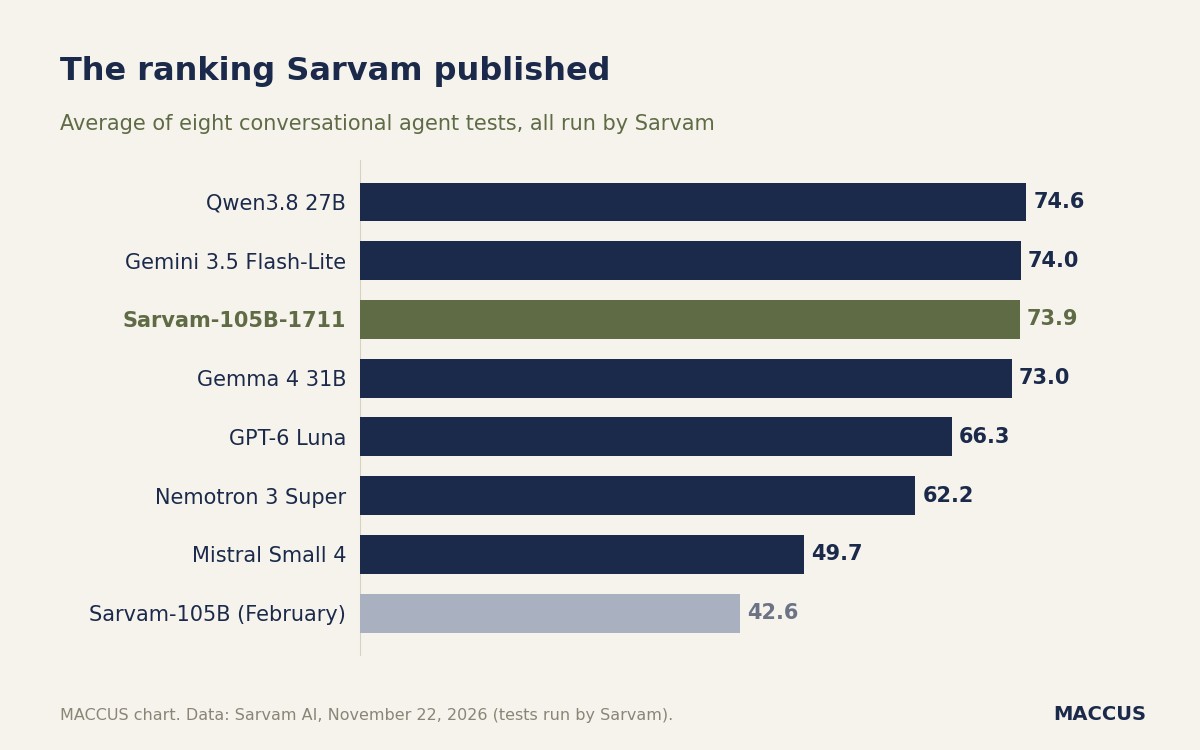
In the same table, Mistral Small 4, an open model from French company Mistral AI, scores 49.7, compared with 73.9 for Sarvam. Mistral AI released the weights of Large 4, its largest model, on October 29.
Sarvam also highlights how consistent its model is. On Tau2, a test built from customer-service tasks, each model gets four attempts per task. Sarvam’s model succeeds on all four attempts in 69.5% of tasks. On that measure, Gemini 3.5 Flash-Lite reaches 63.9%, Gemma 4 31B 62.1% and Mistral Small 4 25.5%.
Sarvam now charges $0.15 per million tokens to use the model on its own online service, down from $0.44. That is a blended price, based on three tokens sent to the model for every token it returns. At the European Central Bank exchange rate of November 20, 2026, the new price is about €0.14, compared with €0.40 before.
Sarvam says it extended the amount of text the model can read in one pass to 160,000 tokens. The configuration on the model card, the technical page Sarvam publishes with the weights, still sets a limit of 131,072 tokens.
Caveats behind the numbers
Sarvam ran every test using its own method. According to the model card, Sarvam ran the open models itself, on vLLM. The closed models, whose weights are not published, were tested through OpenRouter, an online service that gives access to many models.
One of the eight tests, on Indian languages, was designed by Sarvam and graded by another AI model, Google’s Gemini 3.1 Pro. Mistral Small 4 scores only 44.3 on it, which pulls down its average.
Sarvam’s own table also shows where its model trails Gemma 4 31B. On Humanity’s Last Exam, a set of very hard questions answered without tools, Sarvam scores 12.3, compared with 22.1 for Gemma. Gemma also leads on the LiveCodeBench coding test, 81.9 to 75.3, and on creative writing, 89.3 to 65.4.
Qwen3.8 27B, an open model from Alibaba, edges past Sarvam on the eight-test average, 74.6 to 73.9. Qwen has about a quarter as many parameters in total.
Business Upturn writes that these results are no substitute for an independent audit in a bank, a call center or a government office. Superpower Daily, an AI news site, adds that the hardware claim says nothing about the real cost of running the model on site. Superpower Daily also notes that Samvaad, Sarvam’s voice service, relies on a specialized version of the model, separate from the one available for download.
What it means
A 105-billion-parameter model with an open license now fits on a single graphics card, in a compressed format prepared by its own developer. The full 198 GB version needs several cards of this kind. The offline demo is aimed at organizations that do not want to hand their documents to an outside service.
The size claim checks out: the published files do take up 65 GB, less than the card’s 96 GB of memory. The speeds and scores, however, all come from Sarvam’s own measurements. Its tests cover only English and Indian languages, with no published results in French or any other language.
The card itself is a constraint: an RTX PRO 6000 Blackwell is professional equipment. The cache tuning and the vLLM patch also show that running on a single card leaves very little room to spare.
The next things to watch are independent tests, including in French and other untested languages, and whether the patch is added to the official vLLM code. Without that patch, Sarvam says, vLLM would not start on this card with the 8-bit cache. Another open question is whether other open models of this size will ship in formats built for a single workstation card.
Sources
- Introducing Sarvam-105B-1711, Sarvam AI, November 22, 2026
- Sarvam-105B-1711 (NVFP4), Sarvam AI on Hugging Face, accessed November 23, 2026
- Sarvam-105B, Sarvam AI on Hugging Face, accessed November 23, 2026
- [Bugfix] Drop num_stages for MLA decode with fp8 KV cache on small-smem GPUs, vLLM project on GitHub, August 27, 2026
- RTX PRO 6000 Blackwell Series, Nvidia, accessed November 23, 2026
- Sarvam releases updated 105B AI model with single-GPU download, Business Upturn, November 22, 2026
- Sarvam releases upgraded 105B AI model with cheaper hosting and a single-GPU option, Superpower Daily, November 22, 2026