

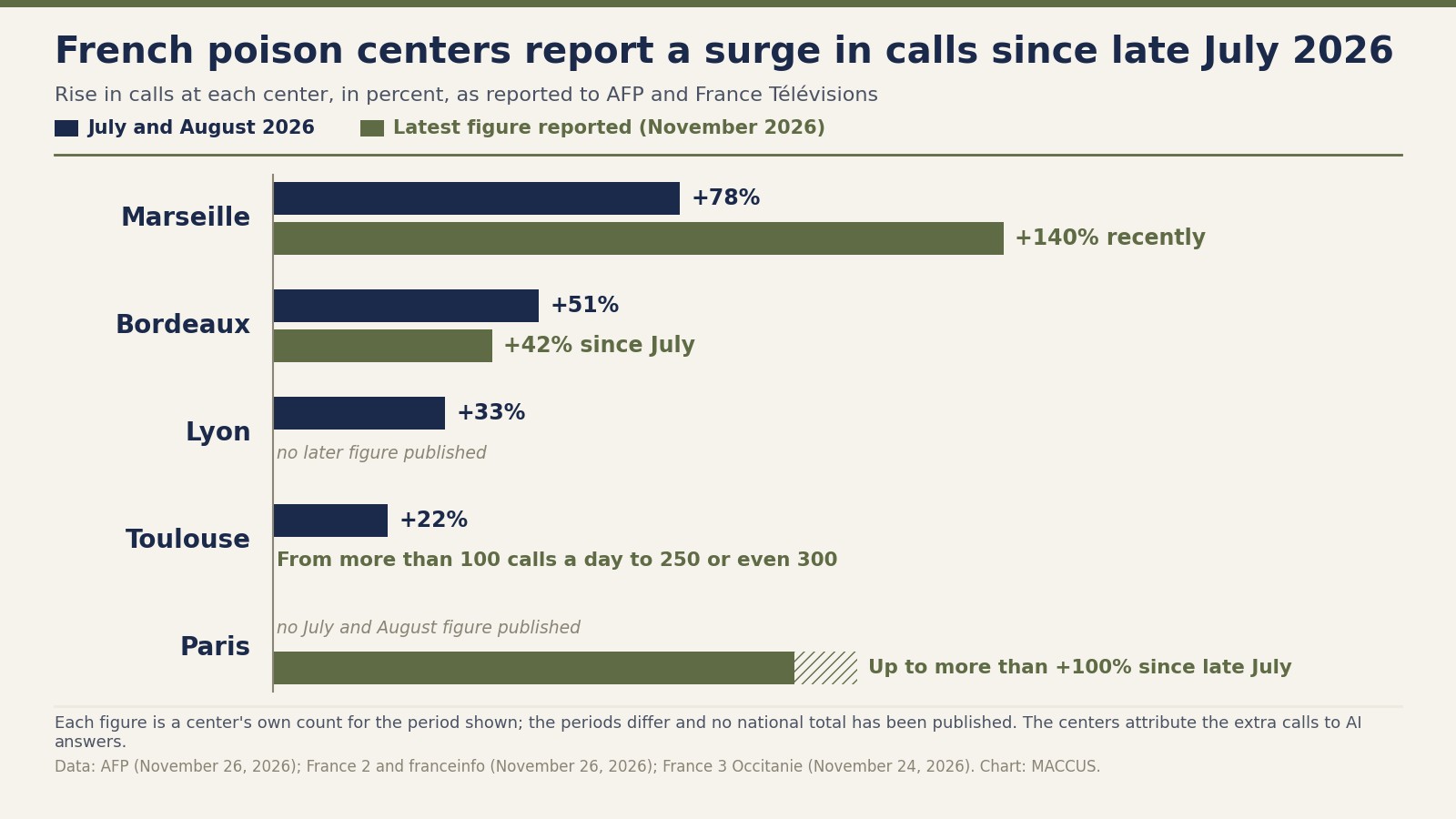
At the Paris poison control center, half or more of callers now say they asked Google or ChatGPT first, according to Dr. Jérôme Langrand, who heads the center at Lariboisière Fernand-Widal hospital. Callers sometimes apologize because their question seems minor to them, he told AFP, the French news agency, “but the AI frightened them and gave them our number.” Since Google launched its AI answers in France in late July, his center’s workload has at times more than doubled.
Many of these calls involve no poison at all. Staff in Paris and Toulouse describe calls about a yogurt one day past its date, a salad that had a slug in it, food picked up off the floor. Dr. Katharina Von Fabeck of the Marseille center wrote to Google, the French firm Mistral AI, ChatGPT and Claude, asking them to improve their tools’ answers. The Toulouse center asked AI companies to stop their tools from referring users to poison control by default on questions with no toxic risk. Neither center has heard back, according to AFP and the public TV channel France 3.
The calls, center by center
France has eight poison control centers. Their doctors are toxicologists, specialists in poisoning. Their lines take calls from the public and from emergency and intensive care doctors.
Professor Nicolas Simon of the Marseille center dates the change to a single day, July 22, 2026. “That is the day everything tipped,” he told France 3 in a report published on November 10. That day, Google launched AI Overviews and AI Mode in France. AI Overviews are AI-written answers shown above the search results. AI Mode is a chat version of Google Search, and our guide to both features explains how they work.
“Calls had held steady for several years, and suddenly we have twice as many. It’s untenable,” Simon said. He added that poisonings have not increased.
The rise varies by city. AFP reports that in July and August, calls rose 78% in Marseille, 51% in Bordeaux, 33% in Lyon and 22% in Toulouse. For Marseille, Von Fabeck told AFP: “Recently, we’re at plus 140%.” In Toulouse, daily calls went from more than 100 to more than 250, “even 300 today,” its head, Professor Nicolas Delcourt, told France 3 in a November 24 report. Bordeaux has logged 42% more calls since July, the public TV channel France 2 reported on November 26.
Who answers the phone
The Paris center has brought in pharmacy and medical students to help, and two doctors have already quit, AFP reports. The center handles about 40,000 poisoning cases a year for the Paris region and the overseas territories of French Guiana and the French Antilles. “No time for a coffee. Or to go to the bathroom. We eat in front of the screen,” a nurse who answers the calls told the agency.
In Marseille, Von Fabeck says colleagues work two or three shifts a week, and AFP reports that some are thinking of leaving. She says the line gets 40 calls an hour between 6:30 and 10 p.m., and the phone “rings nonstop at night, when a single caregiver is on duty.” The center has one line, she said, and it is also the line “where emergency doctors and intensive care doctors can call about a patient in a coma who urgently needs an antidote.”
Reassuring callers takes time too. In Bordeaux, Dr. Magali Labadie, who heads the center, told France 2 that callers do not understand why staff reassure them after the AI worried them, so calls run longer. “It delays care for the most serious patients,” said her colleague Dr. Coralie Braganca. In Marseille, Simon told France 3 that “even saying ‘it’s not serious’ takes at least 10 minutes, we have to rule out every risk.” Medical students take down the first details, but only the senior toxicologist on duty can give the final advice and end the call.
Why the answers point to the hotline
When in doubt, people now turn to Google’s AI answers or a chatbot such as OpenAI’s ChatGPT, Google’s Gemini or Anthropic’s Claude, France 3 reported on November 10. The answer ends by advising a call to the nearest poison center and gives its number.
A France 2 team tested this by asking about a baby bottle made with the wrong amount of milk, for a baby who seemed fine. The AI told the parent not to feel guilty, then pointed to a doctor or a poison center. The report does not say which chatbot it used.
A doctor at the Toulouse center told France 2 that callers say “the AI made me panic” or “ChatGPT told me to call you just in case.” “We get calls for reasons that are neither toxicological nor medical,” Delcourt told France 3. In Marseille, Simon says the AI tools “create extra worry” instead of reassuring people.
These AI answers reach many people. In an Ifop poll published on November 18, 55% of French adults said they had seen Google’s AI Overviews, though only 18% knew exactly what they are. A US experiment found that people clicked through to websites 39.8% less often when Google showed one than when it did not. A Gallup survey published on November 18 polled 15,925 people aged 15 to 22 in 16 countries. Half of those who use AI every day said they had used it as a friend.
Dr. Thomas Lefèvre, a physician and AI researcher, told AFP that the habit of turning to a digital tool, for a recipe, a trip or symptoms, is “already well established.” He calls the overload “a side effect” of how the AI giants roll out their products, and he explains the referral this way: “these companies, under neither French nor European law, don’t want to take any responsibility in health: they will always point to the poison centers so they can’t be blamed for a failure of care.”
The Marseille center will not discourage anyone from calling. “There are too many different situations, we must not miss something serious,” Simon told France 3.
The money and the fixes
On October 14, the association of French poison centers asked France’s health ministry for 2 million euros a year to cope. The ministry told AFP that “solutions are being studied,” and has not said whether it will pay. The Toulouse center has also asked the ministry for more staff and equipment.
The centers are weighing fixes of their own, AFP reports. One is a recorded greeting that asks callers without symptoms to call back during office hours. The others are AI tools that stop recommending a call by default, and fuller public websites. Belgium’s poison control center has already changed its website, but Von Fabeck said it is too early to know whether that worked. Marseille tried to pass calls on to other French centers, but they face the same wave. Simon says centers in Germany, Belgium and Switzerland do too.
In Toulouse, Delcourt’s center normally handles about 60,000 calls a year. Every call must be written up and coded as a medical case, “the same way for a trivial call or a truly urgent one.” He thinks AI tools could automate part of that paperwork so staff can take more calls each hour. He does not expect the wave to fade on its own.
What the numbers don’t show
No national total has been published. Each figure is one center’s own count over its own period, and the periods differ. For Bordeaux, AFP gives a 51% rise for July and August, while France 2 gives 42% since July. AFP does not say what the July and August rises are measured against. In Toulouse, calls rose 22% in July and August and had doubled by November.
The link to AI rests on what callers tell staff and on estimates by center heads such as Langrand. No published study has measured it. No figure shows how many of the calls start with Google’s AI Overviews and how many with a standalone chatbot.
What it means
Four months after Google’s launch, France’s poison control lines give an early sign of how fast people took up AI answers. In Marseille, Simon says poisonings have not increased. The centers trace the extra load to a closing line in the AI answers that sends a worried person to a toxicologist “just in case,” as callers put it, according to a Toulouse doctor interviewed by France 2.
The AI makers control that closing line and can change it in an update. Dropping that default advice is on the centers’ list of fixes. With that change, asking an AI first could take pressure off the lines. Until then, each needless call takes a toxicologist’s time on a line that intensive care doctors also use, and in Paris two doctors have already quit.
One marker is whether Google, OpenAI, Anthropic or Mistral AI change how their tools answer food and poisoning questions in France. Another is whether the health ministry funds the centers’ October 14 request. A third is whether Belgium’s website change reduces calls there.
Sources
- “Manger du moisi, c’est grave ?” : quand les réponses de l’IA embolisent les centres antipoison, AFP (La Libre), November 26, 2026
- “ChatGPT m’a dit de vous appeler” : les centres antipoison débordés à cause de l’IA, franceinfo (France 2), November 26, 2026
- “On nous appelle pour des motifs qui ne sont ni toxicologiques ni médicaux” : quand l’IA fait exploser les appels aux centres antipoison, France 3 Occitanie, November 24, 2026
- “C’est intenable” : ne demandez plus à l’IA si c’est un bon champignon, les centres antipoison racontent comment ils sont saturés d’appels inutiles, France 3 Provence-Alpes-Côte d’Azur, November 10, 2026
- Lancement des Aperçus IA et du Mode IA dans la Recherche Google en France, Google France, July 22, 2026