

On Monday, November 23, 2026, OpenAI started switching ChatGPT’s Chat tab, used for everyday conversation, to a version of GPT-6.2 Sol tuned for that use. That evening, it also set December 23 as the end date for an older model, GPT-5.6 Sol, in ChatGPT. Subscribers on the Plus, Pro, Business and Enterprise plans are getting the newer model, and those who still pick GPT-5.6 Sol have one month left.
OpenAI announced the new model in an entry dated November 23 in the ChatGPT release notes, its public log of product changes. It also posted three times from the official @ChatGPT account on X. In the last one, OpenAI says it will “generally” retire models that are two generations back.
GPT-6.2 Sol itself came out a week ago. OpenAI released it on November 17 with a second model, GPT-6.2 Astra, first for developers and in two other parts of ChatGPT. Those are Work, an agent for longer tasks that researches, analyzes and produces documents, and Codex, OpenAI’s coding tool. Our report on the GPT-6.2 Astra and Sol launch covers that release.
The Chat tab gets a conversation version of GPT-6.2 Sol
The November 23 update brings GPT-6.2 to the Chat tab, which OpenAI had said on November 17 would keep its existing model choices. According to the release notes, GPT-6.2 in ChatGPT “is powered by a version of GPT-6.2 Sol” and “is tuned for everyday conversation.” The system card, the safety report OpenAI published the same day, says the new model replaces GPT-6 Sol. That model took over the Chat tab on October 7.
The rollout “starts” worldwide on November 23, according to the release notes, so some accounts may get the update later than others. It covers the Plus, Pro, Business and Enterprise plans. For Enterprise customers, availability depends on workplace admin settings. OpenAI adds that the models behind Work and Codex are not changing with this release.
OpenAI says the model reads photos and compares options better
OpenAI lists three improvements users might notice day to day. The model picks up finer details in photos, like the text on a label or the symbols on a sign. When users compare options online, it is better at narrowing them down by what matters to them, such as price or location. It also has a better sense of when to offer a follow-up.
The release notes give the example of comparing hotels for a weekend trip. The model can help weigh price against location, then recommend the hotel that best fits the user’s priorities. When a user asks whether something is on sale, ChatGPT can offer to send a heads-up when the price drops.
OpenAI also says GPT-6.2 handles complex requests better, especially those with detailed instructions or those that require finding information online.
Test scores and safety ratings, all from OpenAI
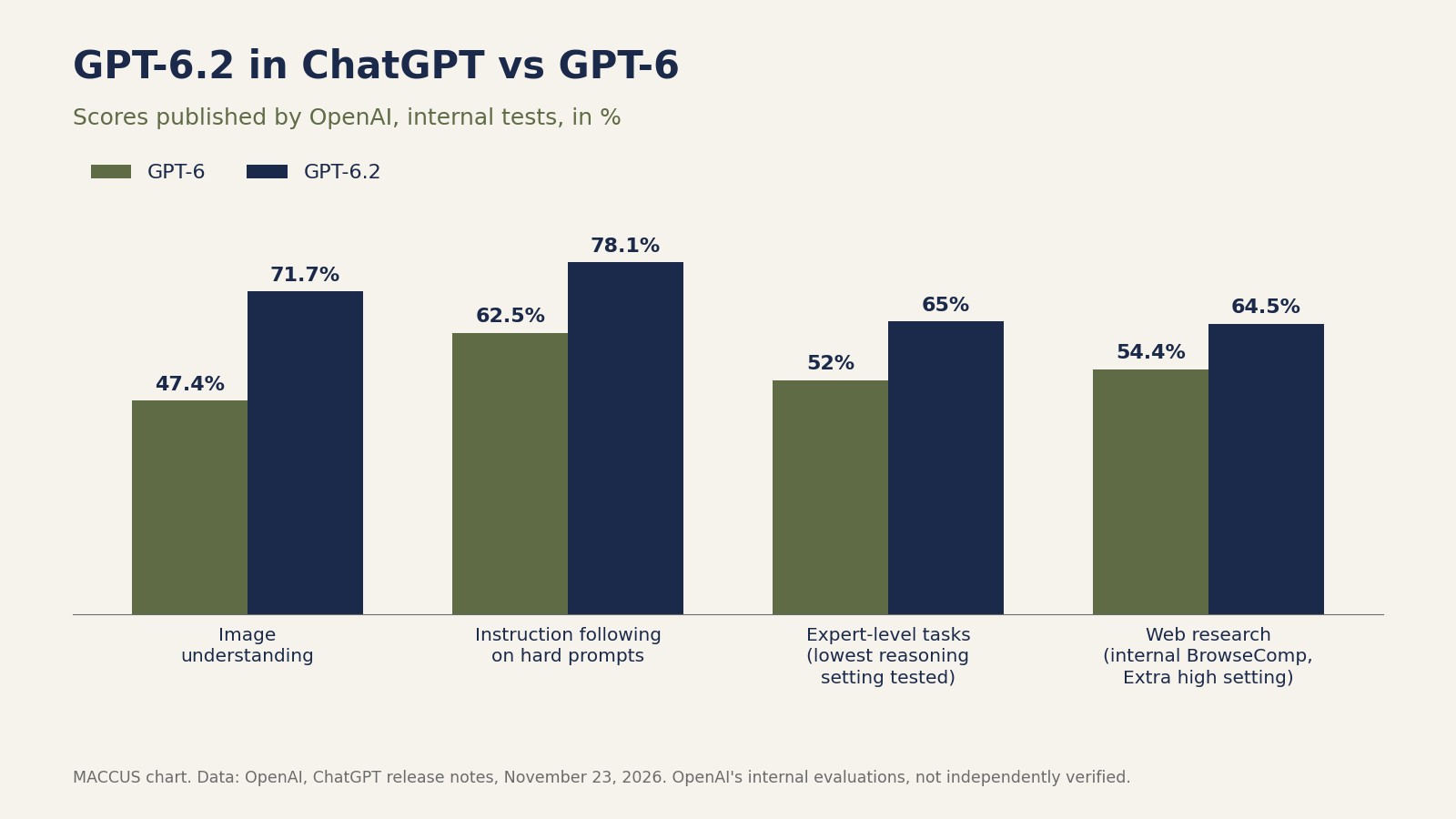
OpenAI backs these claims with four comparisons against GPT-6, all from its own testing. On image understanding, GPT-6.2 in the Chat tab scored 71.7%, against 47.4% for GPT-6. On “especially challenging prompts,” it followed instructions 78.1% of the time, up from 62.5%.
The other two comparisons involve the reasoning setting, which controls how long the model thinks before it answers. On an internal test of expert-level tasks, at the lowest setting OpenAI tested, GPT-6.2 scored 65%, compared with 52% for GPT-6. On an internal version of BrowseComp, a test of finding hard-to-locate information on the web, it beat GPT-6 at all four settings. OpenAI published only one of those four results, at the Extra high setting: 64.5% versus 54.4%.
On safety, GPT-6.2’s responses met OpenAI’s policies in 91% to 94% of the challenging conversations OpenAI tested, up from 77% to 80% for GPT-6. OpenAI also reports gains on its safety tests for teenage users. The largest were in emotional reliance, disordered eating, and age-restricted goods, services and dangerous activities.
The system card also rates the model’s risks on OpenAI’s own scale, the Preparedness Framework, and the company assigns these ratings itself. The model is rated Critical for cybersecurity, and High, below the Critical threshold, for biological and chemical risks.
The model is also rated High for AI self-improvement. It cleared the screening bar on one test and fell short on the other. OpenAI says it took a conservative approach and applied the safeguards for that level.
GPT-5.6 Sol leaves ChatGPT on December 23
The second announcement concerns older models. At 9:42 p.m. UTC that Monday, the @ChatGPT account set an end date for two GPT-5.6 models, GPT-5.6 Sol and GPT-5.6 Terra. “On December 23, we’re deprecating GPT-5.6 Sol in Chat, and GPT-5.6 Sol and Terra in Work and Codex,” OpenAI wrote. December 23, 2026, falls on a Wednesday, exactly one month after the post.
The cut differs by model. GPT-5.6 Sol leaves Chat, Work and Codex. The post names GPT-5.6 Terra only for Work and Codex. It does not mention GPT-5.6 Luna, the member of the family OpenAI made the default for its Free and Go plans in August.
After GPT-6 arrived in October, GPT-5.6 Sol stayed in the Chat model menu. OpenAI’s help page for the Business plan says so: a user who had explicitly selected GPT-5.6 Sol in the model menu stayed on GPT-5.6. That option ends on December 23.
As of the morning of November 24, the release notes did not mention the retirement, so the X post is the only official source. A reply posted on X at 1:50 a.m. UTC on November 24 adds one exception. Fouad Matin, who describes himself as cyber preparedness and safety lead at OpenAI, wrote that “GPT-5.6 Sol will remain available after December 23 through Daybreak Blue.”
Daybreak is OpenAI’s access program for authorized cybersecurity work, open after approval to qualified enterprise customers and security practitioners. Daybreak Blue, its entry tier, makes the models refuse fewer requests for defensive work. That covers tasks such as reviewing code for security flaws, sorting vulnerabilities by severity and responding to security incidents. Nothing in OpenAI’s posts says GPT-5.6 Sol will stay available to regular ChatGPT subscribers.
The GPT-5.6 retirement adds to other departures OpenAI has already announced. OpenAI had set October 14 as the end date for GPT-5.5 in ChatGPT. Custom GPTs, the custom assistants users build in ChatGPT, are set to go away on December 11. The same day, ChatGPT’s Standard and Advanced voice modes will be retired, except for live video and screen sharing.
Retiring models two generations back
A third post, at 10:07 p.m. UTC on November 23, explained the reasoning: “As we roll out new models, we’ll generally continue to retire models that are two generations back. That frees up compute so more people can use our more capable models.” Compute is the computing power OpenAI needs to run its models.
OpenAI wrote “generally,” so the post describes a usual practice and commits to no dates. The release notes already contain an earlier rule. On June 12, when it retired GPT-5.2, OpenAI wrote that models will generally remain available in ChatGPT for 90 days after a successor is released.
In Chat, GPT-5.6 Sol will not get that full window. Its successor, GPT-6, reached the Chat tab on October 7. By December 23, GPT-5.6 Sol will have stayed in Chat for 77 days after that, 13 fewer than the usual 90. In Work and Codex, where GPT-6 Sol arrived on September 22, the overlap will reach 92 days.
What the announcement leaves open
Every performance and safety figure for GPT-6.2 comes from OpenAI’s internal tests against GPT-6. As of November 24, we had found no published independent test of the model.
Nothing in the announcement says whether the Free and Go plans will get GPT-6.2. Those plans appear nowhere in the November 23 release-notes entry, the X posts or the system card. On October 7, OpenAI said they used GPT-6 Luna in Chat.
The documents also differ on who gets the new model. The system card describes a release “for Plus and Pro users,” while the release notes and the X post on the rollout also list Business and Enterprise.
On the retirement side, OpenAI has not said what happens after December 23 to conversations started with GPT-5.6. In June, when GPT-5.2 was retired, OpenAI said existing conversations would automatically continue on the corresponding GPT-5.5 model.
What it means
For Plus, Pro, Business and Enterprise subscribers, this week brings two changes. The model behind Chat moves up a generation without any action on their part. GPT-5.6 Sol, which some people still pick, now has an end date one month away.
The pace is the bigger change. GPT-6 reached Chat on October 7 and GPT-6.2 on November 23, 47 days later. If OpenAI keeps retiring models two generations back, a model someone picks in ChatGPT today could be gone within a few months. For teams that tuned their prompts to a specific model, each new generation means checking them again.
OpenAI justifies these retirements with compute: running fewer old models leaves more capacity for new ones. The Daybreak Blue exception shows that a model retired for regular subscribers can stay in service for a restricted, vetted group of users.
Still to watch is whether an OpenAI help page will confirm the December 23 retirement and say what happens to existing conversations. Other open points are whether GPT-6.2 reaches the Free and Go plans and what the first independent tests show. The last is the point at which GPT-6 Sol becomes two generations old in turn.
Sources
- ChatGPT release notes (GPT-6.2, now in the chat tab), OpenAI Help Center, November 23, 2026
- Post on the GPT-6.2 Sol rollout in the Chat tab, @ChatGPT on X, November 23, 2026
- Post on the end of GPT-5.6 on December 23, @ChatGPT on X, November 23, 2026
- Post on retiring models two generations back, @ChatGPT on X, November 23, 2026
- GPT-6.2 in ChatGPT System Card, OpenAI, November 23, 2026
- ChatGPT Business models and limits, OpenAI Help Center, accessed November 24, 2026
- Fouad Matin’s reply on Daybreak Blue, X, November 24, 2026
- OpenAI Daybreak – Trusted Access for Cyber overview, OpenAI Help Center, accessed November 24, 2026