
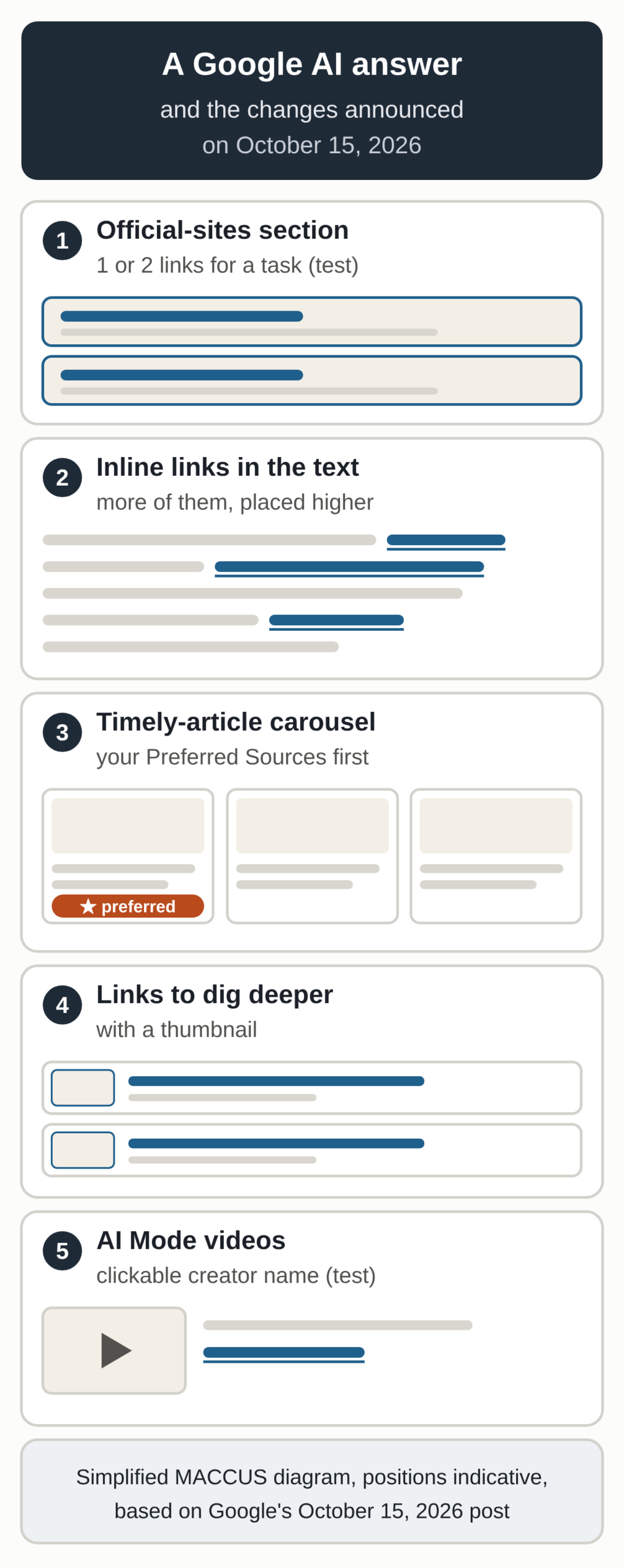
On October 15, 2026, Google announced five changes to how AI Mode and AI Overviews show links to websites. Links inside the answer text are moving higher, Google will test a box reserved for official sites, and news article carousels are reaching new countries. Google names none of those countries, gives no timeline and shares no click figures.
French and Belgian sites may feel this directly. AI Mode and AI Overviews have been live in France since July 22, 2026, on mobile, on desktop and in the Google app. Google does not say which countries get each change.
If you’re new to the topic, our guide to Google AI Mode and AI Overviews explains how Google picks the pages it cites and how to track the effect on your site month by month. This article sticks to the new AI Mode links announced on October 15 and how to measure what they send your way.
Google’s five announcements
The post, by Hema Budaraju, VP of Product Management at Google, went live at 6 p.m. Brussels time on Google’s official blog. It lists five changes, two of which are only tests.
| Change | Announced status | Countries named |
|---|---|---|
| Inline links in the answer text, shown higher and more often | Launching | None |
| A box at the top of the answer for one or two official sites | Test announced | None |
| Carousels of timely articles that highlight the user’s Preferred Sources | Starting to roll out | More countries and languages, no list |
| Links at the end of the answer, with thumbnails | Announced, no date | None |
| Clickable creator and publisher names on AI Mode video results | Testing | Profiles open in Canada, India and the U.S. |
Inline links are links placed on a word or phrase in the answer. Google says it has made “continued and substantial increases” to their presence but doesn’t put a number on it. It is also launching an update that shows them higher up in the answer, and more often.
The official-sites box targets searches where only one or two official sites let you complete a task or find a specific piece of information. Google will test a dedicated section at the top of the answer, with context on why each link is useful. The company doesn’t say how it decides that a site is official.
The carousels for timely articles, launched in May, are starting to roll out to more countries and languages. They highlight the user’s Preferred Sources and are meant to show up on a wider range of queries. The post doesn’t name a single country. On X, Nick Fox, Google’s SVP of Knowledge and Information, described them as “available globally.”
The clickable names lead to Search profiles, Google pages that collect a creator’s or publisher’s work. According to Google’s help page, checked on October 16, 2026, those profiles are available only in Canada, India and the United States, and only to creators with at least 10,000 followers on YouTube, Instagram, X or TikTok. For now, the test doesn’t reach French or Belgian creators.
Seven times more users, with no baseline
Google says the number of people who use Preferred Sources has grown by more than 7x since the start of the year. The post gives neither a user count nor a method, as Search Engine Journal pointed out the same day. The figure measures users, and it comes with no click data.
For a click figure on Preferred Sources, you have to go back to a Google post from May 27, 2026. It said people were twice as likely to click through to a Preferred Source, and that more than 345,000 unique sources had already been selected.
Search Console still doesn’t break out clicks from AI answers
The generative AI performance report, rolled out to all sites on August 31, 2026, shows your site’s impressions in AI Overviews and AI Mode by page, country and device. It has no clicks column.
The clicks are in Search Console, though. According to Search Console’s help page, a click on a link in an AI Overview counts as a click in the regular Performance report, mixed in with the rest of the web results.
An AI Overview takes up a single position on the results page, and all of its links get that same position. A link that moves up inside an AI Overview doesn’t change the position Search Console reports. In AI Mode, position follows the rules of a regular results page.
When Barry Schwartz of Search Engine Roundtable asked, Google said it is continuing to work with site owners and will introduce additional metrics over time. It gave no date.
If your reports have looked off since September, our article on Search Console delays and broken rank tracking walks through the checks to run before you conclude that traffic dropped.
The rules for Preferred Sources
The carousel change ties into Preferred Sources, a documented feature you can act on from France or Belgium. Google Search Central’s page on the feature, last updated September 18, 2026, lays out three rules.
The feature works in all languages for Top Stories, and in AI Mode and AI Overviews wherever those are available. To get the “preferred” badge in those answers, your site has to be included in Search generative AI features in Search Console. Only domains and subdomains are eligible, so a blog in a subfolder such as example.com/blog is not.
Google offers an “Add to preferred sources” button that takes two lines of HTML, or a deep link in the format https://www.google.com/preferences/source?q=yoursite.com for newsletters and social posts. The page notes that neither is required to appear as a preferred source.
Five checks to run now
- Open Search Console, go to Settings, then “Search generative AI.” Your site is included by default. If it has been excluded, your links disappear from AI Overviews and AI Mode, along with the impressions and traffic that come with them. This setting doesn’t affect model training, which you control with Google-Extended, as our article on AI crawlers and robots.txt explains.
- Type your domain into Google’s source preferences tool. If it shows up, add the button or the deep link to your newsletter, social accounts and article footers.
- In the generative AI performance report, open the Countries tab and log impressions from France and Belgium every week, starting October 15. Compare them with clicks for the same pages in the regular Performance report.
- List the pages where people complete a task on your site, such as contact, reservations, returns, cancellations and customer accounts. Google publishes no criteria for its official-sites box, so as a precaution we recommend keeping those pages indexable, each with a clear title and a single canonical URL. That’s our own advice. Google doesn’t ask for it anywhere, and our canonicalization guide explains how to do it.
- Don’t treat a link’s position inside an AI Overview as a sign of progress, since Search Console assigns it the position of the whole block. Rank trackers have also had their own data-collection problems since September, described in our article on the distorted results Google feeds SEO tools.
Carousels, tests and metrics to watch
The first thing to watch for is the carousels arriving in France and Belgium. To check, search AI Mode for a news topic in your industry and see whether an article carousel appears. As of the morning of October 16, we could not confirm whether they show in France yet.
Google has set no date for expanding its two tests, the official-sites box and the creator names. Then there are the “additional metrics” it mentioned to Search Engine Roundtable, with no date and no list. Google hasn’t said whether a clicks column will be among them. That column is what would show the real effect of these changes.
An Agence France-Presse dispatch carried by Le Temps and Le Devoir reports that the announcement comes as news publishers worry about falling traffic. According to the same dispatch, Apig, the group that represents French daily newspapers, raised concerns about Google’s AI summaries with France’s competition authority in August.
The traffic effect is still an open question
Google hasn’t published how much inline links increased, which countries get the carousels or the baseline behind its 7x figure. Two of the five changes are still tests and may never go further. More visible links don’t guarantee more visits, and only your own data, page by page, will show whether they bring any.
For a clear read on how your site performs in Google, request our free SEO audit.