
Ad sets that get fewer than roughly 50 conversions a week ran “about 28% more expensive per purchase” in Meta’s own analysis. The company published the figure on October 21, 2026, in a best-practice post on its Meta for Business site titled “Peak Season 2026: You Don’t Beat The Auction. You Brief It.” The post is tagged “Small business” and is aimed at advertisers heading into peak season.
The same post offers a formula that caps how many ad sets a budget can support, and says most accounts run more than that. PPC Land, a trade site that covers ad platforms, reported on the post on October 25. Meta has not published a French translation: on October 26, the French edition of Meta for Business served the English original.
Campaign structure is also a running topic on advertiser forums. On Reddit in recent days, one advertiser running Meta campaigns asked whether new creatives should be tested in a new ad set or in the existing one. Another described nearly killing an ad on day two that went on to carry the whole month.
A familiar threshold, now with a price tag
Meta’s help page on the learning phase already says an ad set usually exits it “after about 50 results in the week after the ad set’s last significant edit.” During the learning phase, the same page adds, ad sets “are less stable and usually have a higher CPA.” For Shops ads, the bar is 17 purchases through the advertiser’s website and 5 through Meta.
When an ad set is unlikely to get there, Ads Manager labels it “Learning limited.” Meta calls that status “an indication that your budget isn’t being spent effectively” and says it is not a penalty. The causes it lists include a small audience, a low budget, an infrequent optimization event and running too many ads at the same time.
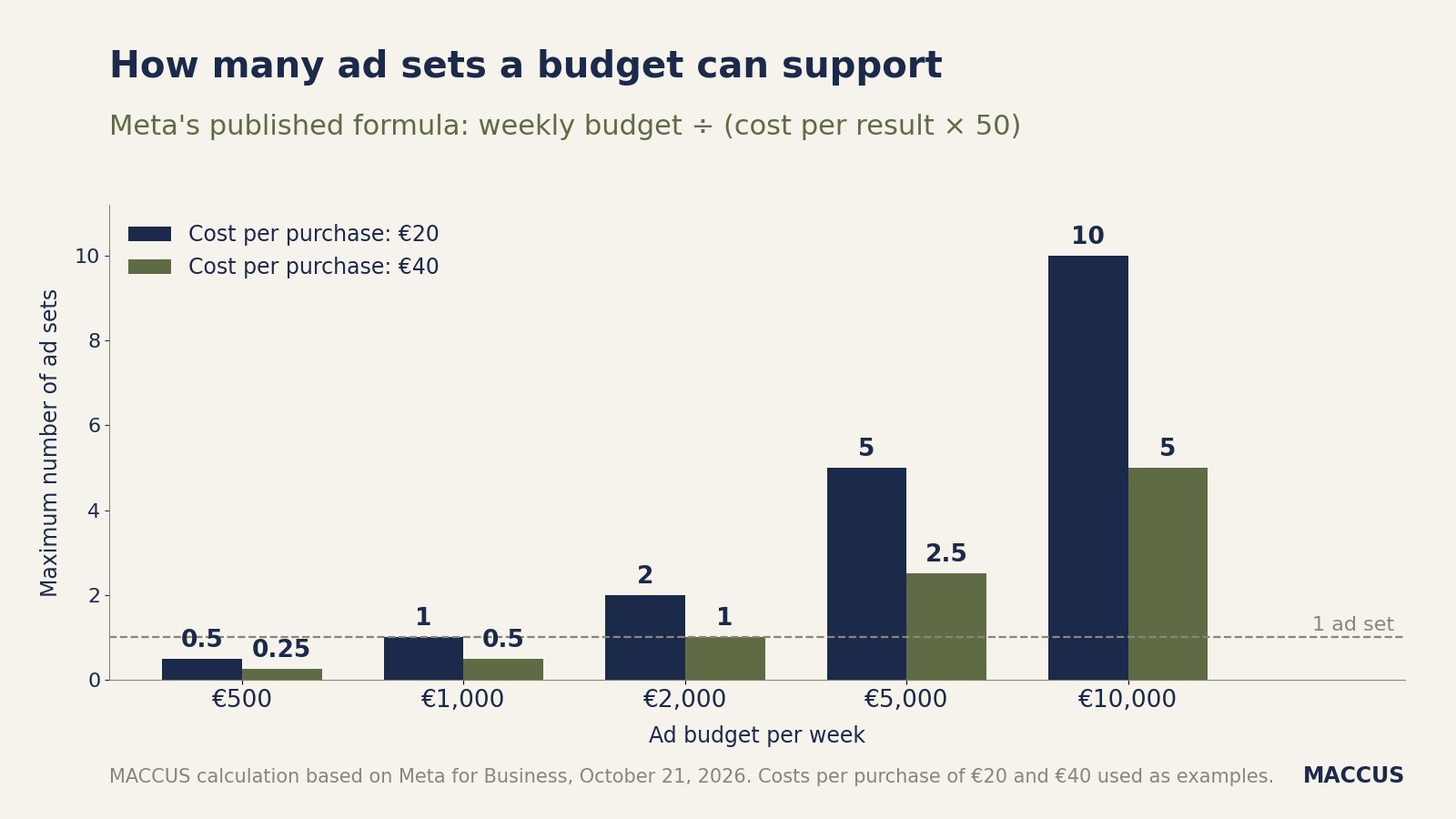
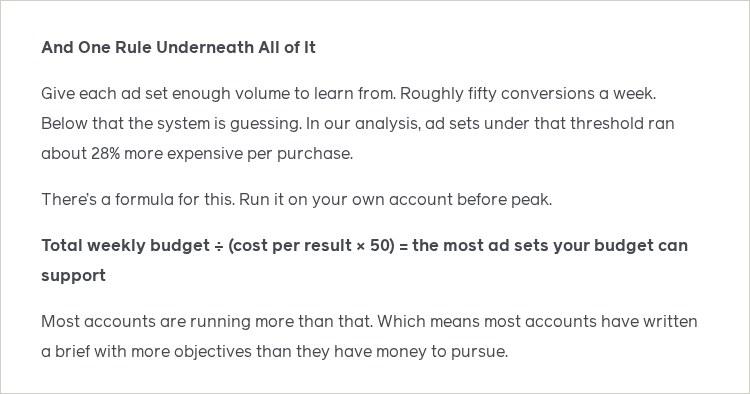
The October 21 post adds two things. “Roughly fifty conversions a week. Below that the system is guessing,” Meta writes, before giving the 28% figure. Then comes the formula: total weekly budget, divided by 50 times the cost per result, equals “the most ad sets your budget can support.” Its conclusion: “Most accounts are running more than that.”
Significant edits restart the clock
Much of the post is about changes made mid-campaign. In Meta’s telling, every change costs twice: once for the learning phase it restarts, and once for the old instruction, which kept spending “at full price” for as long as it was wrong. Only the first cost shows up on screen, with a warning attached.
Meta’s help page on significant edits lists the ones that send an ad set back into learning: any change to targeting, ad creative, the optimization event or the bid strategy, adding a new ad to the ad set, and pausing it for seven days or longer. Whether a budget change counts depends on its size. Meta’s example: going from $100 to $101 is unlikely to restart learning, while going from $100 to $1,000 may.
Google Ads works differently. In an October 15 episode of Google’s Ads Decoded podcast, product manager Tal Akabas said that changing the budget or target of an established campaign does not trigger a learning period. A brand-new campaign, he said, can go through one.
Three settings and a month of patience, according to Meta
The post frames every campaign as a brief handed to the auction, a contractor that never asks a clarifying question. Meta boils the brief down to three decisions. The first is what to optimize for: most accounts, the post says, “optimise for what’s easy to count, not for what the business gets paid on,” meaning conversion volume rather than value.
The second is how hard the system should chase, which is where advertisers can bid more for the customer segments they value most. The third is attribution. “Standard attribution counts what the ads touched. Incremental attribution counts what the ads added. Custom attribution counts it the way your business already counts it,” the post explains.
Under the heading “If You Do One Thing This Week,” Meta tells advertisers to check whether their largest campaign optimizes for the outcome that matters, fix it if not, then leave it alone and measure it with an A/B test or a Conversion Lift study. “Give it the month of October,” the post says. For advertisers with more time, it suggests running the formula across the account and batching changes so they “take one learning phase instead of five.”
A number without a method
Meta does not describe the analysis behind the 28%. The post gives no sample size, time period, region, vertical or campaign type. PPC Land points out that it also does not say whether the comparison controls for budget. Ad sets with smaller budgets, the site notes, are both less likely to reach 50 conversions and more likely to have different costs for reasons that have nothing to do with learning.
Nothing in the post backs up the claim that most accounts exceed the formula’s ceiling, either. The post opens with a statistic: last peak season, 42% of shoppers said they planned to spend less, and they spent 4.2% more. The footnote marker after it has no matching source anywhere on the page. PPC Land also notes that the optimization tools guide Meta links at the end of the post relies mostly on studies from 2024 and the first half of 2025.
The timing raises one more question. Published October 21, the post asks advertisers to hold a campaign still for “the month of October,” when only ten days of it were left. Meta itself will change live ads before the month is out: product browsing switches on by default on October 28 in existing ads for advertisers who have not opted out. PPC Land calls that a rebrief the advertiser did not write.
What it means
The 50-conversion threshold is not new. The October 21 post adds a cost figure and a formula that Meta’s help pages do not contain, published under a “Small business” tag five weeks before Black Friday, November 27. Earlier in October, Meta unveiled new AI tools for advertisers ahead of the same season. This post is about account structure rather than tools.
The formula hits small accounts hardest. At a weekly budget of €500 and €20 per purchase, it returns 0.5: the budget buys 25 purchases a week, so even a single ad set stays below 50. It takes €1,000 a week to support one ad set, or €2,000 if a purchase costs €40. For accounts in that position, Meta’s help page on limited learning lists options besides consolidation, including switching to a more frequent optimization event, such as add to cart instead of purchase.
Ad prices point the same way. With its third-quarter results on October 21, the same day as the post, Meta reported its average price per ad up 14% year over year. If that increase carries through to cost per purchase, the formula allows even fewer ad sets. PPC Land notes that the ceiling drops just as the season pushes many advertisers to launch more campaigns.
Several questions remain open: the method behind the 28%, how many accounts actually exceed the ceiling, and how well the figure applies to the smallest budgets, since Meta gave no breakdown by account size. The post also does not say whether the October 28 product browsing default will count as a significant edit for the ad sets it touches. A published method, if Meta releases one before Black Friday, would settle some of them.
Sources
- Peak Season 2026: You Don’t Beat The Auction. You Brief It., Meta for Business, October 21, 2026
- About the learning phase, Meta Business Help Center, accessed October 26, 2026
- Significant edits and learning phase, Meta Business Help Center, accessed October 26, 2026
- About learning limited, Meta Business Help Center, accessed October 26, 2026
- Meta says ad sets under 50 weekly conversions cost 28% more per purchase, PPC Land, October 25, 2026
- How to guide campaign spend with Google Ads budget and bidding controls, Google Ads (YouTube), October 15, 2026
- Meta Earnings Presentation Q3 2026, Meta, October 21, 2026
Header image: MACCUS chart, calculated from the formula Meta for Business published on October 21, 2026