
Anthropic filed the first amendment to its IPO prospectus with the Securities and Exchange Commission on November 2, 2026. The new version adds third-quarter results and, for the first time, puts a number on the company’s total spending commitments: about $895.4 billion, “substantially all of which” goes to compute and infrastructure. The October 26 version had left that figure blank.
The Claude maker reiterates that it operates in a “compute-constrained environment” where customer demand exceeds the compute available to it. In the third quarter, it bought $5 billion of compute under short-term contracts, at a much higher price than it pays under its multi-year deals. According to the filing, that purchase and $2 billion in charges tied to a donation-matching program pushed it back to an operating loss.
$17 billion in revenue in one quarter
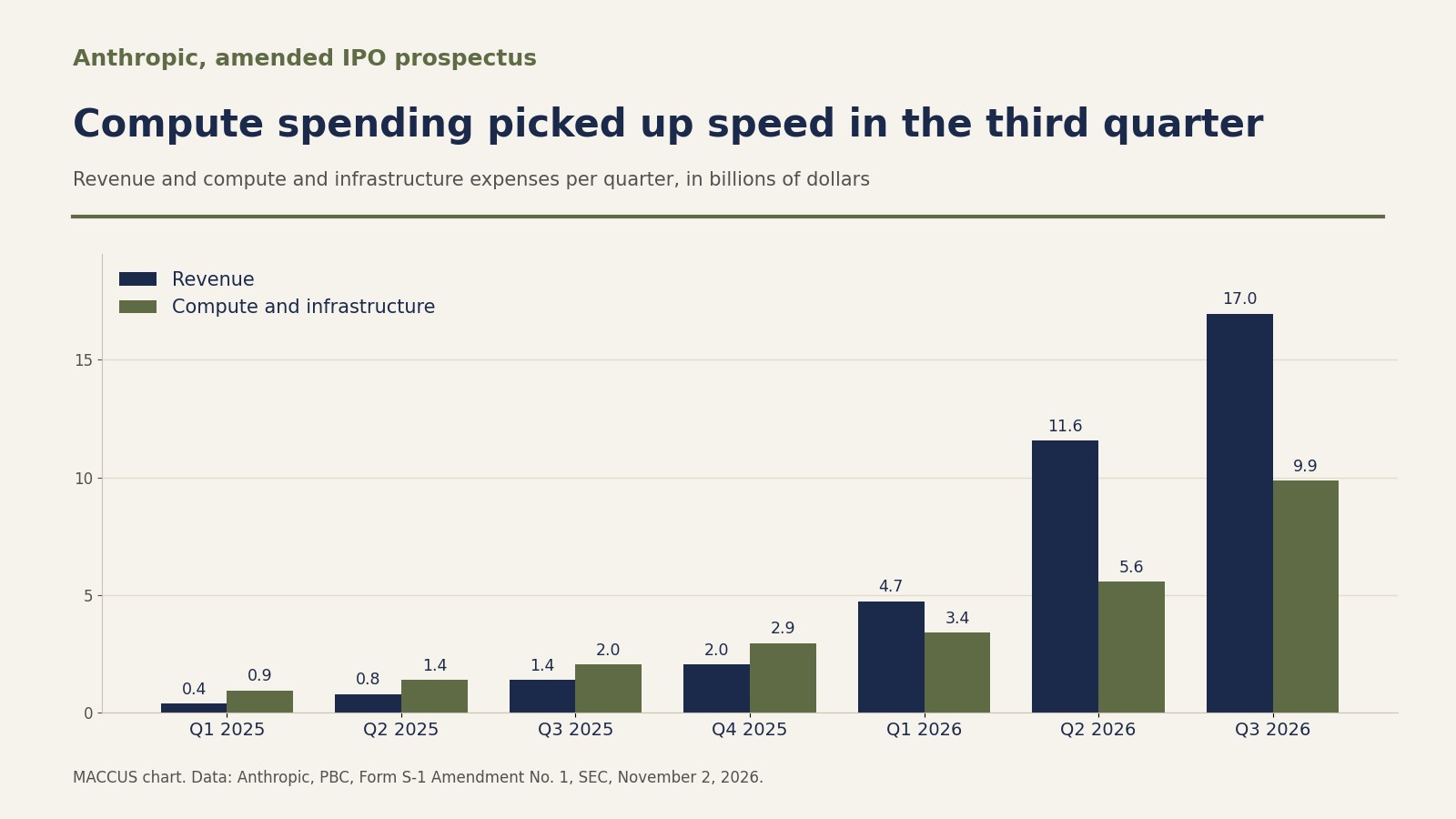
Revenue reached $16.96 billion from July through September 2026, up from $11.56 billion in the second quarter and $1.38 billion a year earlier. Quarter-over-quarter growth slowed to 47% from 144% in the second quarter, Reuters noted. Revenue for the first nine months of the year rose to $33.2 billion from $2.5 billion in the same period of 2025.
Compute and infrastructure expenses grew faster, rising to $9.86 billion from $5.56 billion in the second quarter. They now equal 58% of revenue, up from 48%. Operating results swung from a $974 million profit to a $567 million loss. The filing attributes the swing to the short-term compute and to $2 billion in non-cash charges from the program under which Anthropic matches its employees’ charitable pledges.
The net loss came to $23.3 billion for the quarter and $104 billion over nine months. As in the first half, most of that loss is an accounting effect: $94.3 billion came from changes in the fair value of financial instruments, mainly convertible notes, driven up by the company’s rising valuation.
The filing quantifies the effect of pricing. From the second quarter to the third, price cuts introduced with new model versions and contractual discounts took about $600 million off revenue.
Commitments that run to 2045
Of the $895.4 billion, $447.5 billion is due to be spent before the end of 2030, and most of the rest between 2031 and 2045. About $69.8 billion falls due in the 12 months after September 30, 2026.
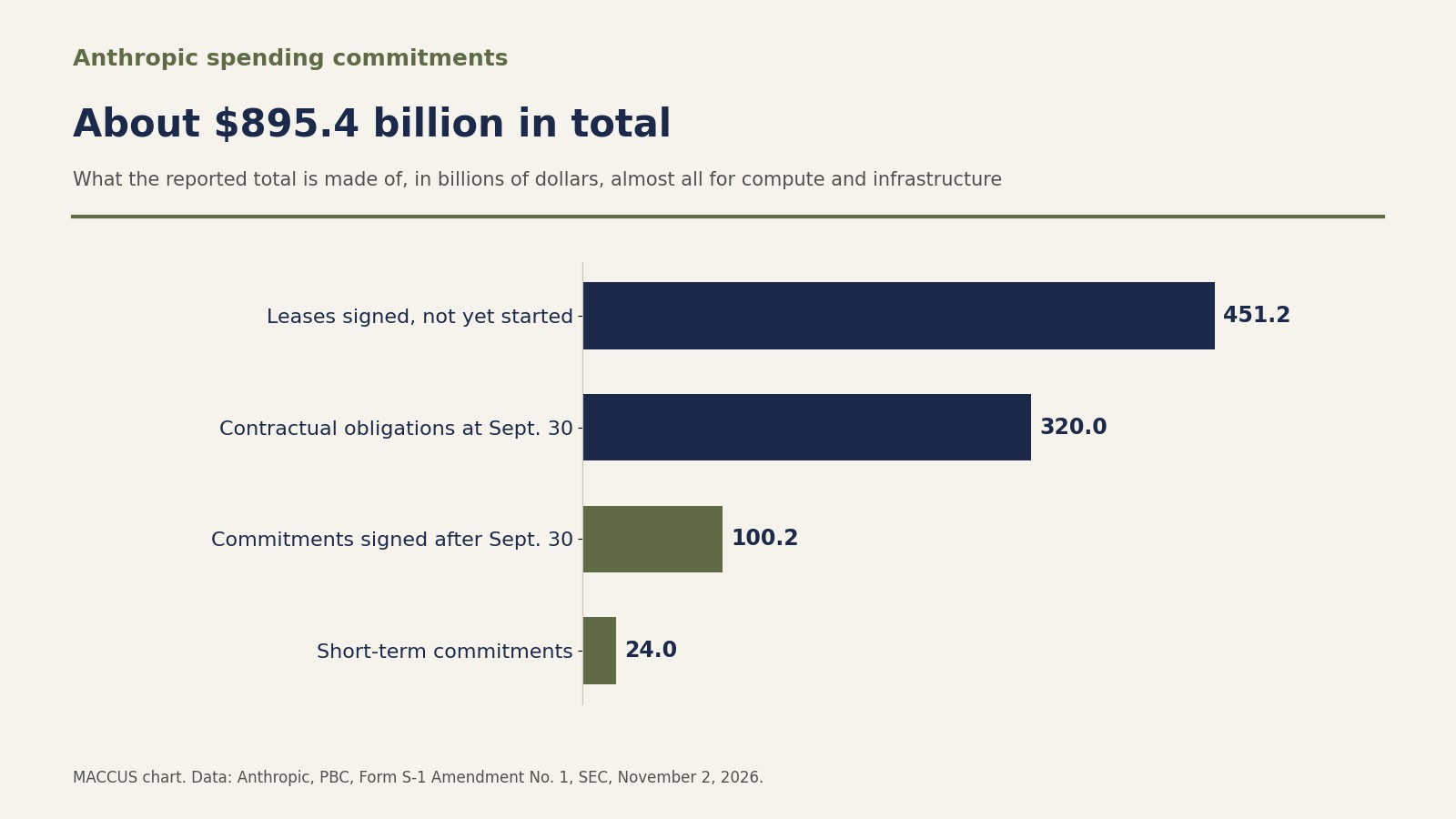
The total is made up of four pieces: $320 billion in contractual obligations as of September 30, $451.2 billion in signed leases that have not started yet, $100.2 billion in commitments signed after that date and about $24 billion in short-term commitments. About $213.8 billion is subject to conditions or termination rights, such as the counterparty’s ability to secure financing, facilities or regulatory approvals.
The filing details the main contracts. Anthropic has committed to spend at least $121.3 billion with Google through July 2033, at least $110 billion with Amazon through April 2036 and at least $44.9 billion with Microsoft through June 2033, “regardless of actual usage.” It has also committed up to $120.5 billion to SpaceXAI, formerly xAI, for NVIDIA-powered compute, and up to $44.6 billion to Nscale. Arrangements with no fixed dollar amount, estimated at $150 billion to $175 billion, are excluded from the total.
On October 30, Bloomberg Tax had already tallied the figures in the first version’s footnotes and arrived at nearly $900 billion. It described the sums as “hidden debt,” since they are not on the balance sheet, and quoted David Trainer, CEO of investment research firm New Constructs: “It’s a huge amount.”
“Customer demand exceeds available compute”
The prospectus makes that point three times. Anthropic says it has sought more compute from its cloud providers than they were willing to supply.
The amendment adds a new risk factor. Some compute providers rely on third-party financing to buy chips, and if that financing dries up or gets more expensive, contracted capacity “may be delayed, repriced, reduced, or not delivered.” Reuters quoted the passage in its November 2 report.
The filing revisits the March 2026 outage, which the company attributes to several factors, including a rapid increase in usage and compute constraints in parts of its infrastructure. If capacity falls short, it warns of service disruptions, slower response times or “limitations on customer and user access.”
The prospectus discusses the usage limits on Claude subscriptions, explained in our guide to the Claude Pro limit: they reset over short periods, and Anthropic says it has changed them before and may do so again. The filing does not explicitly tie them to the compute shortage.
Most of Anthropic’s compute is contracted under multi-year commitments, typically 12 to 18 months in advance. When demand outruns that capacity, the company buys short-term compute, which “currently costs significantly more.” It expects its use of short-term compute to keep rising in the near term and to compress its operating margin as a result.
An AI research threshold that may be close
The amendment rewrites another risk factor, on Anthropic’s use of AI in its own research. The October 26 version warned that the company might not spot a sharp acceleration in its progress in time. The November 2 version says that in the past it identified such an acceleration only after it had happened.
The new text adds an example: based on Anthropic’s internal estimates about future models, the company “may imminently meet” the threshold for “dramatically accelerated progress attributable to AI” set by its Responsible Scaling Policy. Anthropic has not designated any of its current models as exceeding that threshold.
The figures on Anthropic’s internal use of Claude were already in the first version. Valued at list prices, that usage first exceeded monthly personnel expense, excluding stock-based compensation, in April 2026. In September, Claude wrote more than 90% of the contributions to the company’s codebase. Anthropic published data in October on how much of its own work agents now do.
No share price yet, and a profit only on an adjusted basis
The amendment still leaves the share price and the number of shares blank. AFP, citing other media outlets it did not name, reported that Anthropic aims to raise about $100 billion. According to Reuters, the company is set to start marketing the shares to investors the week of November 9.
Several of the figures Anthropic highlights are non-GAAP measures. Adjusted operating income, which came to $2.5 billion, excludes stock-based compensation and non-cash charitable contributions, including the quarter’s $2 billion. The filing also flags a timing mismatch: revenue is mostly consumption-based, with few long-term commitments, while compute contracts run for years.
AFP noted that growth is slowing as Anthropic faces OpenAI and cheaper models, many of them Chinese. Evan Schlossman and Willy Lee, executives at venture capital firm Neostellar, said they will watch when the capacity comes online, when payments start and how revenue tracks those commitments, according to Reuters.
What it means
The first version of the prospectus, filed on October 26, laid out the governance structure and the first-half results. The amendment puts a price on the compute bill and confirms, in the company’s own words, that demand still outstrips supply.
For professionals who work with Claude, the compute shortage helps explain usage limits and slowdowns, even though the prospectus does not make that link itself. The same document shows that new models come with price cuts, and that the stopgap compute Anthropic buys to keep up with demand costs far more than compute under its multi-year contracts. On October 30, the company removed the five-hour limit for verified Ultra accounts, its most expensive individual plan.
The $895 billion total should be read with care: it includes more than $450 billion in leases that have not started and more than $200 billion subject to conditions. The profitability the company highlights rests on an adjusted measure. Revenue is a GAAP figure, although the published quarterly results are unaudited. It is still growing 47% from one quarter to the next, though more slowly than before.
A later filing is expected to set the price range for the shares. On compute, the SpaceXAI capacity is due to be fully delivered in December 2026, at about $3.1 billion a month. Anthropic also says it will publish further reports on the threshold for AI-accelerated research.
Sources
- Anthropic, PBC, Amendment No. 1 to Form S-1 Registration Statement, SEC (EDGAR), November 2, 2026
- Anthropic, PBC, Form S-1 Registration Statement, SEC (EDGAR), October 26, 2026
- La croissance du chiffre d’affaires d’Anthropic ralentit, tandis que les risques liés au financement des ressources informatiques s’accentuent à l’approche de son introduction en bourse, Reuters (on Boursorama), November 2, 2026
- Anthropic says revenue surged 1,100 percent ahead of IPO, AFP (on Yahoo Finance), November 2, 2026
- Anthropic IPO Filing Reveals Nearly $900 Billion in Future Debt, Bloomberg Tax, October 30, 2026
Header image: MACCUS chart, data from Anthropic, PBC (Form S-1 Amendment No. 1, SEC, November 2, 2026).